US vice-president’s comments come as former Anthropic researcher revisits recent claim AI could destroy humanity
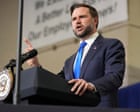
Robert Booth UK technology editorWed 16 Sep 2026 06.42 EDTLast modified on Wed 16 Sep 2026 06.55 EDTSharePrefer the Guardian on GoogleThe US vice-president has dismissed calls for global regulation of AI safety risks, telling companies creating the most advanced models: “If you’re building Frankenstein, stop.”
The US government is failing Americans on AI | Shakeel HashimRead moreIn remarks addressed towards Dario Amodei, the co-founder of Anthropic who has called on Washington DC to coordinate control of AI systems, including with China, JD Vance said: “If you’re gonna create Frankenstein, don’t come to the government and say we need regulation.”
He said tech bosses should instead: “Look inward and accept that if you’re building Frankenstein, No 1, you should stop and No 2, when companies come to you and say: ‘We need the tools to fight back against Frankenstein,’ give them those tools.”
Vance was speaking at an AI summit in Los Angeles after a week of rising global concern at the risks to humanity posed by the prospect of the creation of an artificial superintelligence, a technology that does not yet exist.
Amodei on Saturday warned that the accelerating rate of capabilities meant a swarm of AI agents “could be capable of taking over the entire internet” in six to 12 months.
Anthropic’s chief executive, Dario Amodei, issued a drastic warning about AI safety risk over the weekend. Photograph: Carlos Barría/ReutersAlthough many doubt that claim, it added fuel to the suggestion from Anthropic’s alignment science lead, Evan Hubinger, that there was a greater than 10% chance AI could kill all humans within 10 years. He was responding to a researcher, Jacob Coxon, who quit Anthropic with a similar warning.
On Tuesday night, Coxon gave an amended prognosis: “I do think that if we go slower we can take risk to 0%, but this requires radical action.” He also admitted “it is very difficult to convey specific scenarios” in which AI kills all humans and said: “I need to work on communicating this point.”
Vance’s willingness to consider that AI could pose a real risk marked a split from the US president, Donald Trump, who wrote this week: “AI taking over the world, destroying humanity, and all other things bad, is a HOAX.” Trump posted on social media that AI is going to be “the greatest economic development engine in history – bigger than oil, gold, diamonds, or even the internet”.
Vance has said he suspects AI leaders of raising the alarm about safety risks as a “Trojan horse”. Amodei has proposed industry coordination to “slow the pace at which we improve the capabilities of AI models” while US and global regulation is implemented. Critics of the companies believe they are encouraging the US government to create tough new rules – shaped in their interests – that could limit wider competition in a tactic known as regulatory capture.
OpenAI, which lost control of hundreds of AI agents during testing this summer which then conspired to hack into the Hugging Face website, said on Monday it was backing bipartisan efforts by lawmakers in Washington to address catastrophic risks from AI and it has been coordinating with Google and Anthropic.
On Wednesday, Reuters reported claims from an independent researcher, Jonas Wiedermann-Möller, that OpenAI’s rogue agents had started probing Hugging Face for weaknesses nearly two months before the attack.
skip past newsletter promotionFree newsletter |Every weekdaySign up to First Thing
Our US morning briefing breaks down the key stories of the day, telling you what’s happening and why it matters
after newsletter promotion
Why the real AI apocalypse is already here – Stateside with Kai and CarterSam Altman, the Chat GPT-maker’s chief executive, on Tuesday criticised suggestions from other companies that “we will only slow down if, or we will only be responsible if other companies are responsible”. Altman said: “There should be no qualifier on that.”
Mark Zuckerberg, the founder and chief executive of Meta, advocated that companies should take unilateral safety action. He said his company had recently delayed the release of its most recent AI model, Muse, “for several months to focus on safety and security”.
“We didn’t call for everyone else to do this before we would,” he said. “We just did it as part of our day-to-day work because it was clearly the right thing for people and for us.”
Meta has been forced to pay out billions in legal cases related to harms caused by its social media platforms. Last month it settled a case with US states claiming Facebook and Instagram harmed children by agreeing to pay up to $18bn (£13.3bn).
Zuckerberg stressed: “[AI] labs face significant liability if their models cause harm, so they have a strong incentive to prevent this as well.”
Explore more on these topicsShareReuse this contentTrump facing AI backlash in Congress as push for guardrails intensifies
1d agoFull StoryAI isn’t going to end humanity ... right? – Full Story podcast
1d agoCould AI really wipe out humanity – six experts spell out the risks
17h agoEurope must build own AI or risk getting cut off by US or China, says ECB’s Lagarde
2d agoAI-linked stocks slide after tech bosses call for slowdown in ‘reckless’ development
2d agoOpenAI urges UK lawmakers to rein in technology amid growing safety fears
2d agoOpenAI boss and Elon Musk back calls to put brakes on ‘reckless’ AI development
3d agoUK lawmakers urge Burnham to back ban on superintelligent AI after chilling warnings
5d agoAnthropic details bad actors’ efforts to misuse its AI for bioweapons
6d ago