If you get Global News from Instagram or Facebook - that will be changing. Find out how you can still connect with us.
2:15 Alvin Tedjo defeats Parrish, Crombie to become Mississauga mayor RELATED: Alvin Tedjo defeats Parrish, Crombie to become Mississauga mayorCities and provinces across Canada have seen political change in recent months as frustrations over affordability and quality of life has meant incumbents being shown the door.
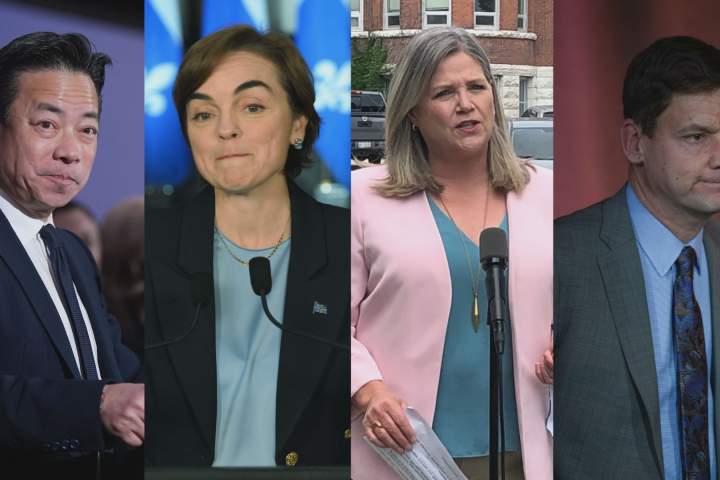
Multiple Ontario cities said goodbye to short and long-time mayors and councillors on Monday. A few days earlier, British Columbia ousted its NDP government and premier David Eby, following the trend of incumbent losses after several B.C. mayors were voted out of office. Those changes all came in a month that started with Quebec’s CAQ government losing every seat in the provincial election.
The back-to-back changes were a result of Canadians facing continued strain over tariffs from the U.S. administration, wavering inflation and uncertainty when affordability will get better, political experts said.
“If we think about the national mood right now in Canada … I think a lot of Canadians don’t feel like they’re getting ahead,” said Lewis Krashinsky, a political scientist and William Lyon Mackenzie King postdoctoral fellow at Harvard University. “Voters can be fickle.”
He said that when voters don’t feel like they’re getting ahead, they look for people they believe can bring new ideas.
Richard Johnston, professor emeritus of political science at the University of British Columbia, said the power of incumbency has decreased over decades. Previously, some provincial governments have served for decades such as the Progressive Conservatives in New Brunswick for 17 years, or the Alberta PCs for 43. The average length of a government now sits at about 10 years.
4:35 Breaking down the results from Ontario electionsIncumbents have also faced multiple issues in recent months, with Johnston saying the handling of COVID-19, supply chain and inflation, and President Donald Trump’s tariffs have meant Canadians are feeling worse off.
Get daily National news
Get daily Canada news delivered to your inbox so you'll never miss the day's top stories. By providing your email address, you have read and agree to Global News' Terms and Conditions and Privacy Policy.As a result, people are pointing the finger at politicians in city hall or the provincial legislatures and punishing them for it.
“In general, this has been a decade of sort of institutional failure, I think that’s actually unfair, but that’s how voters perceive it,” Johnston said. “There’s a sense in which governments of almost any stripe seem to have dropped the ball or they’re overwhelmed by forces beyond their control.”
But Krashinsky, originally from Toronto, added that voters can choose someone new for a number of reasons including anger.
“Perhaps that’s out of a sense of anger, resentment towards a political candidate who’s been in there for so many years; perhaps it’s a sense of optimism with what the new candidate could bring in,” said Krashinsky. “Perhaps it is a sense of just needing a better option; it’s a sense of almost desperation that we’ve tried this path over and over again, and we haven’t gotten ahead.”
1:57 Canada’s longest-serving mayor loses electionLong-time incumbency ended for several mayors in Ontario Oct. 26.
- Alberta government to end DEI public sector hiring
- Danielle Smith faces another leadership review call from UCP constituency board
- What’s next for the BC NDP? Veteran MLA says party must ‘listen and learn’
- Former Ontario cabinet minister who resigned over expenses scandal defends promotion
Gord Krantz, Canada’s longest-serving, lost his first election since becoming mayor of Milton in 1980. Further south, Sarnia’s Mike Bradley ended his 38-year run in the mayor’s seat defeated by newcomer Carrie McEachran.
It wasn’t long-time incumbents who lost either. One-term mayors in B.C. including Port Moody’s Meghan Lahti and New Westminster’s Patrick Johnstone, and Mississauga’s Carolyn Parrish and Hamilton’s Andrea Horwath in Ontario also lost.
Hamish Telford, associate political science professor at the University of the Fraser Valley in B.C., said those short-term mayors were the victims of the public disappointed in their own choices within the previous four years.
“It’s frustration with lack of progress on core issues as a generality,” he said. “People look over the past four years and say, ‘my life or my city hasn’t improved like you promised it would,’ and obviously, they come to the conclusion that the direction that the mayor set was not the right one.”
2:29 Olivia Chow wins re-election on a council stacked with progressive alliesNot all incumbents are losing though, with Toronto Mayor Olivia Chow, Brampton Mayor Patrick Brown and several B.C. mayors still keeping their jobs.
Krashinsky said the reasons can range from a mixture of relatability to there not being a strong enough opposition candidate to give voters another strong choice.
“Affinity for a candidate that you know and recognize and trust someone perhaps that you’ve met,” he said. “Being able to have that personal touch that you can be established really over time I think can really help these incumbents.”
Yet Telford added even likeability won’t help if voters are losing respect for the judgment of longer-serving incumbents creating that need for change.
“The winds of change of change blow every decade in Canada and that’s what we’re seeing lately,” Telford said.
—with files from Global News’ Aaron D’Andrea and Amy Judd
Add Global News as a Preferred Source on Google to see more of our stories in your search results.
Journalistic standards Report an error © 2026 Global News, a division of Corus Entertainment Inc.