As fires ravage Indonesia, emitting a toxic smoke that has drawn the ire of regional neighbours, the government is testing an unusual new approach to tackle the haze: dry ice.
Having tried cloud seeding, water bombing and sending in army personnel to fight the fires, Indonesia’s coordinating security minister said dry ice would be dropped on the province of South Sumatra on Thursday.
“This trial of dry ice dispersal is being conducted under the president’s direct instruction to help tackle the haze in South Sumatra,” minister Dudung Abdurachman was quoted as saying by state news agency Antara.
“We will first observe the results, and if effective, there is a possibility that this method could be implemented in other regions.”
Since January, almost 900,000 hectares have been burned Indonesia-wide in the worst fire season in more than a decade, exacerbated by this year’s “godzilla” El-Nino and as the practice of “slash and burn” to clear land for crops such as palm oil persists.
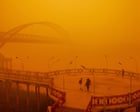
Motorists ride through thick haze from wildfires in Palangkaraya, Central Kalimantan, Indonesia. Photograph: GENDES/EPAFor months, millions of Indonesians have been subject to thick smoke and an apocalyptic tangerine haze, with criticism mounting of the government’s response, including a class action lawsuit filed last week accusing it of “gross negligence”. Tens of thousands of people have sought treatment for respiratory illness linked to the haze.
Air quality has also plummeted in neighbouring countries, shuttering schools, grounding flights and driving a spike in respiratory illness.
Marina Bay, Singapore, before and after smoke haze caused by fires in Indonesia.The haze has drifted into neighbouring Singapore, Malaysia and as far afield as the Philippines. Timor-Leste has said it would shut schools nationwide for three days from Thursday and urged families to keep children indoors or to use “respiratory protection” if going outside.
Singapore rolled out subsidies for haze-related medical treatment starting on Monday, a measure last activated in 2015 when similar blazes occurred. The city-state has also begun distributing N95 masks to eligible residents.
In the past week, the financial hub of Singapore was listed among the most polluted cities globally. Kuala Lumpur, also deeply affected, was at number two.
Kuala Lumpur’s skyline shrouded in haze from regional wildfires, Kuala Lumpur, Malaysia, on 9 October. Photograph: Hasnoor Hussain/ReutersOn Thursday, a Cessna aircraft will reportedly disperse 1.5 tons of dry ice over the South Sumatran city of Palembang, a move the government hopes will ease the smoke and improve air quality and visibility.
The technique was first deployed in the 1940s to promote ice formation in clouds, Bloomberg reported.
‘The physical toll is visceral’: How Indonesia’s fire haze affects millions - visual guide Read moreBut experts say the use of dry ice, or solid carbon dioxide, might only offer local, and limited relief.
“It’s got some potential for local relief that might work for a while,” says Rick McRae, an adjunct professor from the University of New South Wales’ (UNSW) bushfire research group.
A pedestrian wearing a mask walks along the boulevard at Marina Bay in Singapore this week. Photograph: Roslan Rahman/AFP/Getty Images“Weather systems are all moving from east to west. So if you’re in a town under that and you clear the smoke, there’s gonna be more blowing all the time,” he says, “So it’s a constant … It’s not going to be simple and it’s not going to be a permanent fix in any way.”
In the Indonesian province of central Kalimantan on Wednesday, the ISPU air pollution index exceeded 1,200 – or four times the “hazardous” level of 300 – environment ministry data showed.
Local news footage showed thick haze blanketing the provincial city of Palangka Raya, cutting visibility for motorists to a minimum.
Thick wildfire haze shrouds the Kahayan River in Palangkaraya, Central Kalimantan, Indonesia. Photograph: GENDES/EPAIndonesian president Prabowo Subianto has ordered firefighting efforts to be stepped up, and called for a crackdown on those suspected of starting fires.
But the government has struggled to combat the fires, the worst of which occur in peatland areas, can burn for weeks underground, and are difficult to extinguish.
“As time goes by and climate change kicks in, I think it could become a global problem, not just the fix that one country needs to find,” said McRae, of the widening regional issue. “There’s a lot of interconnectedness on a global scale.”