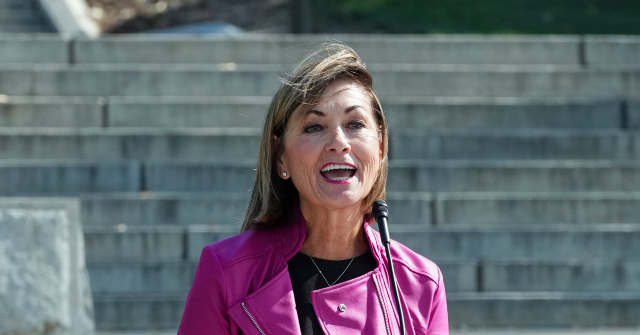
Iowa Gov. Kim Reynolds (R) signed a bill on Tuesday that restricts mail-order abortions.
House File 2788 bans abortion inducing drugs from being prescribed through telehealth and mail-order services and requires the drug, called mifepristone, to be prescribed in person, Iowa Capital Dispatch reported.
The law will take effect on July 1 and comes as Louisiana battles the U.S. Food and Drug Administration in court over a Biden-era policy allowing abortion pills to be sent via mail in the wake of the Supreme Court’s Dobbs decision.
The FDA first approved mifepristone in 2000 by classifying pregnancy as an “illness.” At the time, guardrails for the drugs — called Risk Evaluation and Mitigation Strategies (REMS) — required that only doctors could prescribe the drug, mandated three in-person visits before they could do so, and directed that they report serious adverse events.
Since then, safety regulations have been slowly chipped away, including in 2016, when the agency said healthcare workers need to report only fatalities.
The pro-abortion Biden administration temporarily suspended the in-person requirement in 2021 and made the change permanent in 2023 as an act of defiance after the Supreme Court overturned Roe v. Wade. The FDA’s mail-order scheme has enabled abortionists in blue states to mail abortion drugs into states with pro-life laws, and blue states have passed “shield laws” protecting abortionists from adverse legal action in red states.
The State of Louisiana, along with Rosalie Markezich — a woman who alleges her boyfriend was able to order abortion drugs online from California and coerce her into taking the pills — filed a lawsuit against the FDA in October 2025. The lawsuit argues that the FDA acted unlawfully by loosening safeguards around mifepristone and allowing it to be sent via mail, including violating the Administrative Procedure Act (APA).
Earlier this month, a three-judge panel for the U.S. Court of Appeals for the Fifth Circuit blocked the policy and issued a scathing rebuke of the FDA’s 2023 REMS action permanently removing the in-person requirement. The panel wrote that the Biden administration’s removal of the in-person requirement was an explicit attempt to undermine pro-life state laws in the wake of the Supreme Court’s Dobbs decision and pointed out that the FDA itself has now admitted the move is not backed by rigorous science.
The circuit court also found that Louisiana has standing to sue, is facing irreparable harm both legally and financially, and will likely succeed in its challenge on the merits.
The drug companies, Danco Laboratories and GenBioPro, appealed to the Supreme Court alleging imminent financial harm, and the High Court ultimately decided last week to allow the mail-order abortion policy to continue during litigation. Conservative Justices Samuel Alito and Clarence Thomas dissented.
Thomas notably wrote that mailing abortion pills is a violation of the Comstock Act.
“I write separately to note that, as Louisiana argued below, it is a criminal offense to ship mifepristone for use in abortions. The Comstock Act bans using ‘the mails’ to ship any ‘drug… for producing abortion,’” Thomas wrote. “A neighboring provision makes it a felony to use ‘any express company or other common carrier or interactive computer service’ to ship ‘any drug… designed, adapted, or intended for producing abortion.’”
“As relevant to this case, mifepristone shipped to Louisiana, which bans abortion, causes nearly 1,000 abortions per month. All of this violates the Comstock Act,” he continued. “Applicants are not entitled to a stay of an adverse court order based on lost profits from their criminal enterprise. They cannot, in any legally relevant sense, be irreparably harmed by a court order that makes it more difficult for them to commit crimes. And, whereas it would serve the public interest to reduce applicants’ opportunity to commit crimes, a stay would have the opposite effect. I respectfully dissent.”
The lawsuit will continue to play out in lower courts and may appear before the High Court again for further review.
In 2023, the Guttmacher Institute estimated that medication abortions accounted for 63 percent of all abortions within the formal U.S. healthcare system. That percentage was up from an estimated 53 percent in 2020 and 39 percent in 2017. The report did not account for abortion pills obtained through underground national and international networks, including those that send pills to women in states with abortion restrictions.
The pro-abortion organization estimated that 91,000 telehealth abortions were provided in 2025 under blue state shield laws to people in states with abortion restrictions.
In a medication abortion, mifepristone blocks the action of progesterone, which the mother’s body produces to nourish the pregnancy. When progesterone is blocked, the lining of the mother’s uterus deteriorates, and blood and nourishment are cut off to the developing baby, who then dies inside the mother’s womb. The drug misoprostol (also called Cytotec) then causes contractions and bleeding to expel the baby from the mother’s uterus.
Katherine Hamilton is a political reporter for Breitbart News. You can follow her on X @thekat_hamilton.

