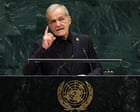
Iran’s president, Masoud Pezeshkian, turned the tables on Donald Trump, describing America as the true bully and terrorist in the Middle East while also insisting that Iran had always shown a commitment to the negotiating table.
In a defiant speech to the UN general assembly in New York, his first since the US and Israel launched an all-out war on Iran, Pezeshkian repeatedly vowed that Tehran would never bend the knee to America.
But he balanced defiance with a willingness to talk, saying: “It must be understood by President Trump and those who seek to bully us that we are ready for dialogue and diplomacy and negotiations but without the language of force.”
On Tuesday, the US president had told the UN he was weighing whether to “annihilate” Iran, but went on to hail renewed talks between Tehran and Washington’s negotiators.
A surprise three-hour meeting between Iran’s foreign minister, Abbas Araghchi, and the US special envoy Steve Witkoff on the sidelines of the assembly the same day was regarded as constructive by both sides. It was the first such meeting since June, but did not stop the US delegation from walking out at the start of Pezeshkian’s speech.
The Iranian president did not go into any details about the talks, but conveyed the impression that he was focused on wining the support of Iran’s Arab neighbours for the proposals Tehran has drawn up for the future of the strait of Hormuz, the vital waterway which has been intermittently blockaded since the start of the war, causing global energy prices to spike.
He made it clear that Iran could not tolerate the strait being used to transport arms that could then be used against it, a statement that suggests Iran will demand the right to inspect ships travelling through the strait in the future. Iran’s goal, he said, was to live independently.
Pezeshkian accused Washington of “terrorism” for assassinating Iran’s former supreme leader Ayatollah Ali Khamenei at the start of the war. He held up photographs of the dead leader and more than 150 schoolchildren killed in the opening days of the conflict, before insisting Tehran had never started a war.
He also insisted Iran had the right to pursue a peaceful civil nuclear programme but did not want to build nuclear weapons.
He repeatedly argued that the answer to regional security lay in agreement within the region and not with outsiders such as the US. Iran did not see its neighbours as security rivals, he said, but as partners in security.
“In today’s world, those that are unable to defend themselves will be trampled upon,” he added.
Iran has repeatedly targeted US allies in the region since the start of the war.
Insisting Iran was the victim of true terrorism, Pezeshkian questioned why “Israel kills, yet Iran is subject to sanction”. He added: “They kill, we are sanctioned. Iran did not seek special treatment but wanted equal rights.”
The leader’s attendance at the UN’s signature diplomatic event, in the heart of Manhattan, had been in doubt as it was unclear whether the US would issue a visa.
Ultimately Washington granted the permit, but denied visas to several members of Pezeshkian’s entourage.
In Tehran, the foreign ministry spokesperson, Esmail Baghaei, confirmed talks had taken place between the two sides, but appeared not to confirm any shift in the Iranian negotiating position.
He said: “The interaction that took place with the American side was through Qatari mediation. This interaction was aimed at conveying Iran’s conditions, including the end of the war in all its dimensions, the cessation of American aggressive actions, the naval siege, and the economic war, the release of Iranian assets and so on.”
Aware of the potential domestic backlash, he added that Iran’s conditions had been conveyed.
Iran set seven preconditions before returning to talks, and in a new development over the past 48 hours said the crucial strait of Hormuz could be reopened within seven days if those conditions were met.
It is likely that the US and the Gulf states would have to accept a navigational route for shipping in the strait of Hormuz that requires commercial shipping to enter through a sea lane mainly in Iranian waters and under Iranian rather than Omani control.
The fact that the talks lasted three hours suggests some progress was made. The US side is under pressure to leverage down oil prices and increase the availability of refined oil before the midterm elections in November. The latest published figures suggest the number of identifiable tankers making it through the strait is fewer than five a day.
The blockage in the strait is made worse by uncertainty surrounding the control by the Houthis – the Iranian-backed Yemeni paramilitaries – of a second energy transport chokepoint, the Bab al-Mandab strait that leads from the Red Sea into the Indian Ocean.
There is little sign that Trump wants to relaunch a full-scale war with Iran, or indeed with the Houthis, as Republicans battle to turn the domestic political agenda away from a hugely unpopular conflict that Americans think they are losing.
Iran is under ever more intense pressure from sanctions, and a US naval blockade is making it nearly impossible for it to export oil, depriving the country of badly needed foreign currency. Iran’s civilian aircraft on Wednesday faced a potential worldwide grounding owing to the threat of US secondary sanctions on any entity that engaged with Iran’s civilian fleet.
Iranian officials negotiated frantically with neighbouring countries to try to maintain an air bridge, but it appears that Oman and Iraq have been forced to close their airspace to Iranian civilian planes.