Japan's defence minister has rebutted Beijing's claim that his country was engaging in a "new militarism" - criticising China for its military expansion and lack of transparency.
Shinjiro Koizumi argued it was actually China and its "huge arsenal" of weapons that was of "serious concern" to the international community.
His remarks, on the last day of a defence summit in Singapore, were some of the most pointed yet from Tokyo in response to China's repeated criticism of Japan's military build-up under Prime Minister Sanae Takaichi.
The two countries have a long history of tensions stemming from Japan's invasion of China during World War Two.
Last week, a day before the Singapore summit began, China's national defence ministry spokesman Jiang Bin had warned "the grey rhino of a remilitarised Japan is gathering speed" and called on the international community to "work together to contain Japan's neo-militarism".
Japan has been steadily increasing its defence budget, setting spending records for 12 consecutive years. Its latest budget, approved in December by its cabinet, is for more than 9 trillion yen ($57bn; £42bn) - moving the country closer to its target of spending 2% of its GDP on the military.
The Japanese government has previously insisted it was not seeking war and only wants to bolster its defences.
In his speech on Sunday at the Shangri-la Dialogue, Koizumi said it was "only natural" that every country, including Japan, updates its defences to meet new challenges and to contribute to peace in the region.
He sought to reassure the roomful of officials from Asian countries, including several that were invaded by Japan in WW2, by promising Japan would proceed "with a high degree of transparency" and engage in constant dialogue with other countries.
"What are we developing these capabilities for? And based on what thinking? Japan will move forward while making a clear explanation to the international community," he said.
Koizumi rebuffed the idea that Japan was engaged in "new militarism", saying it was "nothing further from the truth".
"There's a country that has a huge arsenal of nuclear weapons and strategic bombers," he said, in a veiled reference to China. "Japan has neither of these weapons. And yet Japan is labelled [with] 'new militarism'. Isn't it strange?"
Anti-war protests rock Japan as PM pushes for stronger defence
Japan’s 75-year pacifism hangs in balance as new threats loom
Following his speech, a representative of the Chinese military asked whether Japan would issue an apology to China, South Korea and South East Asian victims in WW2.
Shinjiro Koizumi sidestepped the dialogue participant's question while taking aim at China.
"China continues to increase its defence spending at a high level and is rapidly expanding its military capabilities across a wide range of areas without sufficient transparency," he said.
"China's external approach and military activities are matters of serious concern for Japan and the international community."
He added that "Japan's door is always open" for communication with China.
The issue of Japan apologising for wartime atrocities has long been a sticking point in the two countries' relations, with China in the past criticising some of the apologies as insufficient. Koizumi's father, Junichiro Koizumi, issued several apologies when he was prime minister.
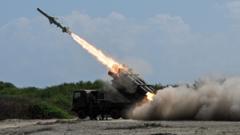
Japan's PM Takaichi has taken major steps to boost defence since taking power in October 2025. With its increased military budget, Japan plans to invest in new surface-to-ship missiles and unmanned drones deployed on land and underwater.
Japan has also recently relaxed rules that will allow it to sell lethal weapons to other countries, in a move that will help build up its defence industrial base. It will also be revising key security documents by the end of this year.
Takaichi has also pushed for revising Article 9 of Japan's constitution - a pacifist clause that renounces war.
Tensions with China have escalated, peaking in November when Beijing took issue with Takaichi's suggestion that Japan could respond with its own self-defence force if China attacked Taiwan.
Takaichi's moves have also deeply divided Japan.
Some support increased defence against potential threats such as China, while others fear it could escalate the possibility of confrontation.
There has also been fierce debate over whether Japan is moving away from its post-war pacifism, a core part of the national identity.
In recent months, anti-war protests have been held across the country, with some swelling to become Japan's largest in decades.
JapanChinaRelatedJapan benefit from new World Cup substitution rule
Litterbugs now face on-the-spot fines in Tokyo's tourist hotspot
At least 19 people taken to hospital after 'strong smell' reported at Tokyo mall
More from the BBC17 hrs agoChina goes after 'ghost kitchens' to rein in cut-throat food delivery apps
17 hrs ago18 hrs agoSteph Curry signs with Chinese brand after Under Armour split
Chinese firms have been vying to secure deals with big stars as they push to become global brands.
18 hrs ago19 hrs agoInfluencers sought to sell Cambridge homes in China
An estate agent is looking for tech-savvy students to help find buyers in China and Hong Kong.
19 hrs ago2 days agoWatch: Glass doors break as fans scramble to see Pursuit of Jade star
Huge crowds formed outside a shopping centre in China to see actor Zhang Linghe.
2 days ago2 days agoSecret tunnels and unregistered workers: China's coal mine disaster is a reminder of darker days
China's worst coal mining disaster in 15 years comes amid an ambitious pivot towards green energy.
2 days ago