The economy was slowing even before the Middle East conflict and interest rate hikes started to bite, while the boom in datacentres was a rare bright spot
Get our breaking news email, free app or daily news podcast
The economy slowed sharply in early 2026 and Australians’ living standards are once again going backwards.
At the risk of upsetting the treasurer by “talking down the economy”, as he put it, there wasn’t all that much to love in the latest national accounts.
And a lot of the bad news was papered over by the extraordinary rush to build datacentres.
How will datacentres affect Australia’s power prices, water supply and emissions? Read moreThe economy was indeed running hot in the second half of 2025, which helps explain the pickup in inflationary pressures even before the US and Israel started bombing Iran in late February.
That recent strength accentuates the slowdown in the latest figures.
After expanding by 0.9% in the December quarter, real GDP growth faltered to just 0.3% in the three months to March.
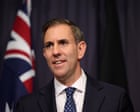
Speaking to the press after the release of the official figures, Jim Chalmers remained laser focused on the annual growth in real GDP, which was steady at 2.5% in the year to March.
“This growth is really solid in the circumstances,” the treasurer said.
“You think about everything that’s coming at the Australian economy. The fact that we’ve got any growth at all, given the challenging global circumstances, I think is welcome.”
He lauded the extraordinary boom in building datacentres to cater for the looming artificial intelligence revolution. We haven’t seen this pace of new business spending since the end of the mining investment boom nearly 15 years ago.
Investment in machinery and equipment – which captures the datacentre phenomenon – was the single largest contributor to growth in the quarter, the Australian Bureau of Statistics said.
But that had to be balanced against the fact that most of the parts were imported, the ABS noted, which contributed to the big drag from net trade.
Sign up for the Breaking News Australia emailEven so, Pat Bustamante, a senior economist at Westpac, reckons that the spillover effects to other parts of the economy from all that datacentre construction still added 0.5 percentage points to total real GDP growth in the quarter, and about 0.8 points to the annual growth rate.
“Outside of this, investment and economic activity were weak, with the pick‑up in household consumption offset by a fall in public demand,” Bustamante said.
“This shows that the economy was clearly slowing even before the conflict in the Middle East and interest rate hikes had really started to impact.”
The pressures are most clearly shown in household incomes that are barely keeping up with inflation, according to Commonwealth Bank analysis.
Economic growth per person also went backwards in the March quarter – a sign of falling living standards. That’s the first time in a year that’s happened.
Overall consumption was up, but almost all of that was more spending on essentials, like electricity (as rebates rolled off) and fuel (as petrol prices climbed in March).
To pay for those additional costs, households saved less. Spending on non-essentials barely budged.
So now what?
The outlook is a bit grim. These national accounts only captured the beginning of the global oil shock, as Chalmers recognised.
“When you remember that this data doesn’t capture the worst parts or the worst consequences of the war in the Middle East, then obviously we can expect some challenging times ahead,” he said.
The longer the strait of Hormuz remains closed, the worse the effects on the global economy.
Overall, it looks set to be a pretty gloomy year, and consumer confidence is certainly down in the dumps. Unemployment is still relatively low, but recently jumped up to 4.5%.
A recession as per the technical definition – the economy shrinking for two consecutive quarters – can’t be ruled out.
Especially if the Reserve Bank believes it has to keep hiking rates to get inflation under control, despite a weakening economy.
But the treasurer, for all his positive spin, is right: we are not in a terrible place leading into the latest global crisis.
Patrick Commins is Guardian Australia’s economics editor
- Australian economy
- Reserve Bank of Australia
- Jim Chalmers
- Inflation
- Cost of living crisis
- Unemployment
- Interest rates
- analysis
LiveAustralia politics live: PM calls Taylor ‘Temu-Abbott’; Liberal housing spokesperson calls for bigger CGT discount than John Howard’s
now…… commentsCapital city home prices fall as experts predict Australia’s property slump could last a year and cut values by 10%
3d agoAustralia’s truckies were already struggling to survive. Then the fuel crisis hit
3d ago…… commentsOne Nation says it wants a Norway-style gas policy – but it’s not actually in favour of higher taxes on profits
17h ago…… commentsHundreds of thousands of Centrelink payments cancelled illegally, Albanese government admits
1h agoThe chips are down: pizza, fried chicken and doughnut shares plunge on ASX as living costs bite budgets
30 Apr 2026High stakes: who’s leading the fight against Labor’s CGT reform – and what’s in it for them?
6d ago…… commentsMinister dismisses Labor colleague Ed Husic’s criticism of secondhand Aukus submarines deal as ‘disingenuous’
4h agoAustralian lenders all have an ‘edge of cliff’ mortgage interest rate. Here’s how to push them to it and get a better deal
6 May 2026…… commentsModelling shows 90% of young Australians will be better off under Labor’s tax reforms
6d ago
