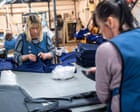
More than 1,200 people, including Ben Fogle, sign letter saying domestic contracts will help preserve UK manufacturing
Lauren CochraneTue 15 Sep 2026 04.10 EDTLast modified on Tue 15 Sep 2026 04.55 EDTSharePrefer the Guardian on GoogleLondon fashion week is only days away, but one industry organisation has turned its attention to clothing that is a little less catwalk-worthy – the uniforms worn by British defence forces and NHS staff.
On Wednesday afternoon, the thinktank Fashion Roundtable will hand deliver a letter to Downing Street urging Andy Burnham to commit to manufacturing these uniforms in the UK.
Signed by more than 1,200 people – including the adventurer Ben Fogle and The Great British Sewing Bee presenter Patrick Grant – the organisation’s letter says public procurement such as this could be vital to preserving the UK’s manufacturing industry.
Kardashian curves: M&S launches £28 bodysuit with exaggerated hip paddingRead more“The biggest lever we have to support skills retention, inclusive growth and regional resilience is awarding public procurement contracts for textile goods to suppliers who manufacture onshore in the UK,” the thinktank said.
According to a Fashion Roundtable economist’s estimate, about £120m is spent a year by the NHS and Ministry of Defence on uniforms, with 55% of them currently manufactured overseas.
The benefit of domestic manufacturing to an economy has already been demonstrated. The Covid inquiry concluded that nearly £10bn of public money was wasted on the flawed way it went about buying personal protective equipment (PPE), much of it manufactured in China. By contrast, Scotland, which invested £102.7m in PPE and produced 88% of it domestically in 2021, generated £66.7m of additional economic value and 1,400 jobs.
Kate Hills, the founder of the manufacturing organisation Make It British, said making these items in the UK could allow companies breathing space. “These sort of contracts would give manufacturers confidence to employ more people, to look at the long term rather than feel like they’re surviving day to day,” she added.
Some British army uniforms are made in China, but the US manufactures its military uniforms domestically by law. Photograph: Ben Birchall/PAThe US is an example where contracts for military uniforms are manufactured by companies within the country by law, thanks to the Berry amendment, which was passed in 1941. In 2025, the market for the industry reached $1.62bn (£1.19bn).
Hills said she hoped Burnham might commit to this change – partly because of his own taste for UK-made apparel: he buys suits from the Manchester-based brand Private White VC, for example. The Labour leader has argued that government procurement should do more to support UK manufacturers rather than prioritising the lowest-cost overseas suppliers.
“Maybe he is the prime minister that sees the value of products that are actually made here,” Hills said.
skip past newsletter promotionFree newsletter |Every weekdaySign up to Business Today
Get set for the working day – we'll point you to all the business news and analysis you need every morning
after newsletter promotion
Grant invested in Blackburn-based military outfitters Cookson & Clegg in 2015. Its last military contract, making uniforms for the British army, stopped in 2009 and it now makes the designs for his label Community Clothing, with almost 2,000 employees. He agreed that government procurement would be a boost. “Manufacturing requires steady state business with good visibility [and] long-term demand,” he said. “That’s the kind of thing that government procurement can do.”
He said he would “absolutely” like to bid for such contracts but even if they were for British companies, the process was “unfeasibly complicated … unless you’re a 20,000-employee operation with an enormous clerical department … Something needs to happen on that side, too.”
Concerns have been raised over army uniforms being made in China. In July, Iain Duncan Smith dubbed it a security concern, telling the Telegraph it was “tantamount to having our uniforms made by Nazi Germany in the 1930s”.
Grant said: “We are currently producing a lot of stuff in countries that we do not have the most stable relationships with. If something bad were to happen, we would have no resilience at all in our supply chains.”
The entrepreneur said procurement legislation would go some way towards future-proofing employment; creating jobs for people to make things that would always be needed. “We have to try to think about where jobs are going to come from in the version of our society that we’re going to have in 10 years’ time when AI really starts to kick in,” he added. “Why not just get ahead of it?”
Explore more on these topics- Manufacturing sector
- NHS
- Health policy
- Defence policy
- Ministry of Defence
- Military
- Public services policy
- news
UK manufacturing growth picks up as Trump tariff chaos eases
3 Aug 2026Listen to manufacturers and unions: high electricity prices are killing industry
15 Jun 2026Britain ‘faces deindustrialisation’ without relief from high energy prices, survey warns
15 Jun 2026UK economy shrank by 0.1% in April as Iran war held back growth
12 Jun 2026UK poised to ease steel tariffs as manufacturers warn of costs
10 Jun 2026Rolls-Royce secures nearly £600m in UK government cash to develop small reactors
13 Apr 2026Centuries-old pottery firm Denby set to call in administrators
31 Mar 2026UK car production falls 17% as industry warns of ‘worrying’ decline
27 Mar 2026UK manufacturers hit by sharpest rise in cost inflation since Black Wednesday in 1992
24 Mar 2026Nissan ‘says Sunderland plant could close’ if UK excluded from Made in Europe rules
5 Mar 2026