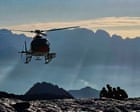
A significant cache of unexploded bombs from the first world war emerged this summer from rapidly retreating glaciers in the Dolomites, the Italian army has said.
The devices, which included Italian artillery shells and French mortar bombs, were removed and defused by the army’s Julia Alpine brigade, according to a statement.
The weapons originated from the white war, a battle between the Austro-Hungarian army and Italian troops across treacherous and bitterly cold terrain between 1915 and 1918.
Soldiers from Italian army’s Julia Alpine brigade at work. Photograph: Julia Alpine brigadeMore than a century later, hikers reported several sightings of bombs during the summer, mostly in the area of Canal San Bovo in the Primiero Valley in eastern Trentino. The soldiers then conducted an extensive sweep there and across other high-altitude and glacier locations in the Trentino Alto Adige region of the Dolomites.
They recovered and neutralised 250 explosives, including “18 Italian 75mm artillery shells and 37 Thevetot mortar shells – a French-made device that was also supplied to the Italian royal army during the first world war”, the Julia Alpine brigade.
It is not the first time that relics of the white war have emerged from melting glaciers, whose retreat has accelerated over more than decade.
A soldier with some of the munitions recovered. Photograph: Julia Alpine brigade“It is very much a consequence of global heating,” said Stefano Morosini, a professor at the University of Bergamo and the coordinator of heritage projects at Stelvio national park, where some of the explosives were also found.
“In recent years, at the end of each summer, these dangerous artefacts emerge and each year there is a higher number. They have been conserved by the ice for more than 100 years. Some had already exploded but many hadn’t, so now when they re-emerge, they are very, very dangerous.”
The advice to hikers and mountaineers is to “never touch any type of explosive device you might find, regardless of where it is located” and to promptly report any discovery to police.
Fought mainly in the Dolomites of Trentino Alto-Adige and the Alps of the Lombardy region, the white war was a period of history frozen in time until the 1990s, when global heating started to reveal an assortment of perfectly preserved relics, including weapons, sledges, letters and diaries.
skip past newsletter promotionFree newsletter |WeeklySign up to This is Europe
The most pressing stories and debates for Europeans – from identity to economics to the environment
after newsletter promotion
Melting ice reveals first world war relics in Italian AlpsRead moreA wooden barracks that had been dug into a cave on the top of Mount Scorluzzo, a 3,095-metre (10,154ft) peak overlooking the Stelvio pass, reappeared in 2015 after the ice which had sealed it off for almost a century completely melted.
The shelter had been hastily locked up when the first world war ended in November 1918, and the soldiers abandoned most of their belongings. Beds made of straw as well as clothes, lanterns, newspapers, postcards, coins, and tinned food were found well preserved inside.
A white war museum to host the relics is scheduled to open in Bormio in June 2027.
The white war is thought to have claimed more than a million lives, although the majority of soldiers were believed to have been killed by avalanches, falling down mountains or hypothermia.
Dozens of corpses, some still in their uniforms, have emerged from the melting ice over the past 15 years.
The relatives of an Italian soldier were able to bury him in 2017 after documents revealing his identity were found with his body on Presena glacier.
Morosini said the intense summer heat was making access to the glaciers in the Dolomites less safe. Eleven people died when a huge mass of the Marmolada glacier broke off in 2022.
“It is becoming more and more impossible to access the glaciers during the summer because of the very long heatwave at high altitude,” he said.
“If you come to the area, you can see how fast the glaciers are retreating and how strong the impact of climate change is.”