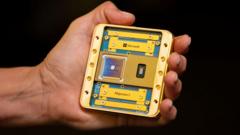
Microsoft says its new quantum chip is vastly more reliable than its previous version, paving the way for a quantum computer solving commercially useful problems within three years.
At the heart of quantum computing are qubits, which offer the promise of answering questions that defeat today's machines, but are notoriously delicate and unstable.
Microsoft says the qubits on Majorana 2, its new chip, survive for an average of 20 seconds, rather than the milliseconds of Majorana 1.
That means the new chip is 1,000 times more reliable - an improvement in performance the tech giant compares to the difference between a phone that needs charging every day to one which needs charging every few years.
"We will have a quantum machine in 2029 that can solve commercially viable, reasonable problems", said Zulfi Alam, corporate vice president of Microsoft Quantum.
That would still require huge further advances as such a device would require millions of qubits - the current chip, Alam said, has 12.
Assessing the firm's claims are difficult because it does not release the full details of what it has discovered publicly, citing commercial confidentiality.
There is a worldwide race to develop the technology, given its potential to take on tasks currently considered too enormous for even the most powerful traditional computers.
Microsoft has spent 20 years pursuing an approach to quantum computing known as "topological".
The firm's approach to this is based on exploiting the properties of a so-called quasi-particle, which had existed only in theory, since it was first predicted in the 1930s by Italian physicist Ettore Majorana.
To do this it had to exploit a novel state of matter - different from the three familiar states of liquid, solid or gas.
Paul Stevenson, a physics professor at the University of Surrey, said the tech giant's timeline sounded plausible - if its research lived up to its claims.
"Microsoft appears to have made a leap in their attempt to produce viable topological qubits," he said.
"If they succeed, they will leap from being a player with no production quantum computer, to being a serious player in the race to make the next generation of fault-tolerant machines."
Explained: How quantum computers workFalse start
Microsoft's focus on topological qubits has, at times, been controversial.
It was forced to retract a paper published in the journal Nature in 2018 in which it claimed to have found evidence for the Majorana.
But it continued working on it, and its first Majorana chip was released in 2025.
However, Microsoft faced considerable scepticism, including over its claims about Majorana's, from unconvinced experts.
Henry Legg, a physicist at the university of St Andrews, told the BBC at the time that in his opinion Microsoft's quantum research had "moved firmly away from science and entered the realm of faith".
Today, Jason Zander, executive vice president of Microsoft Quantum and Discovery, said: "We stand behind it 100%.
"We really look to scientific rigor. We welcome the debate that has always been part of physics... the key thing I would tell people, go read the papers and look what's there, go talk to the experts that we have given deep information to."
Microsoft is part of the final stage of a quantum development programme run by the US defence research agency Darpa which aims to "verify and validate the firm's utility-scale quantum computer concept" and says it has shared all of its data and workings with it, including commercially sensitive material, for assessment.
But a paper its published alongside the announcement has not been peer reviewed - a process where it is reviewed by independent experts - and scientists the BBC spoke to wanted more information.
The second generation of the Majorana chip is based on the same principles as the first but is more effective in part because the scientists replaced aluminium with lead as a superconductor.
While the team is using AI to try to improve and speed up its efforts, Zander said it was human scientists who had come up with the idea of changing materials.
The qubit quandary
Microsoft's hoped-for timeline raises the possibility of its quantum computers taking on problems which could take decades to solve, such as getting rid of microplastics, or coming up with better fertilisers for food production.
Zander said he could see a role for humans, AI and quantum computers.
"If you look at removing forever chemicals, getting rid of microplastics, things like that, those are things traditionally, if we take 15, 20, 30 years to figure out that's a very long time," he said.
"We want to compress that time cycle as much as possible, and so being able to have humans with AI move quicker and compress that timeframe, I think is actually great.
"So it's not about eliminating humans, it's about giving humans tools that can help them accelerate that process, that's actually going to help society, I think."
But holding that process back is the fundamental difficulty of quantum computing.
Qubits are extremely fragile and even tiny changes in temperature or a small vibration can affect them and cause errors.
Keeping them going for longer is a big challenge for the entire quantum industry.
Quantum machines are in their infancy and while many companies are racing to build a scalable computer, nobody is known to have succeeded yet.
Some also think we may have written off the computers of today too soon.
"We don't know what the limit [of classical computers] is," Sir Demis Hassabis, the co-founder of Google Deepmind, recently told author Sebastian Mallaby in the book The Infinity Mind.
King's College team wins access to cutting-edge Google quantum chip
Powerful quantum computers in years not decades, says Microsoft
Sign up for our Tech Decoded newsletter to follow the world's top tech stories and trends. Outside the UK? Sign up here.
MicrosoftQuantum computingRelatedCritics say Forza Horizon 6 is one of year's best video games
London AI office space leases rise tenfold in year
US to safety test new AI models from Google, Microsoft, xAI
More from the BBC5 days agoKing's College team wins access to cutting-edge Google quantum chip
5 days ago13 Apr 2026Quantum computing: A tech race Europe could win?
With some promising computing companies in the field, could Europe be a leader in quantum tech?
13 Apr 202629 Mar 2026'Quantum computing talent should be used for good'
After the government's pledge to invest £2bn into quantum computing, how is the industry feeling?
29 Mar 202620 Jan 2026Greenland 'will stay Greenland', former Trump adviser declares
20 Jan 20268 Jan 2026Inside the sub-zero lair of the world's most powerful computer
Faisal Islam gets rare access to Willow - Google's quantum computer.
8 Jan 2026