The US president said in an interview ahead of the United Nations meeting that he was considering ‘wiping Iran out’
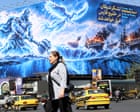
LIVE Updated 2m agoYohannes LoweTue 22 Sep 2026 03.40 EDTFirst published on Tue 22 Sep 2026 03.14 EDTShareKey events An Iranian woman in Tehran walks next to an anti-US billboard carrying a sentence in Persian that reads, 'The devil army will be drowned in the Persian Gulf' Photograph: Abedin Taherkenareh/EPAAn Iranian woman in Tehran walks next to an anti-US billboard carrying a sentence in Persian that reads, 'The devil army will be drowned in the Persian Gulf' Photograph: Abedin Taherkenareh/EPAYohannes LoweTue 22 Sep 2026 03.40 EDTFirst published on Tue 22 Sep 2026 03.14 EDTShareFrom 28m ago03.14 EDTIRGC warns it will 'change the geography of the war' if US escalates the conflict
Iran’s Revolutionary Guard Corps warned it would “change the geography of the war” if the US escalates the conflict, after Donald Trump issued fresh threats against the Islamic Republic.
In an interview with Fox News on Sunday, Trump said “very big things are going to be happening in the not-so-distant future”, adding that the options he was considering were “wiping Iran out, letting them rot economically or making a deal”.
A spokesperson for the IRGC, Hossein Mohebbi, responded with a warning that if the US were to launch fresh attacks against Iran, Tehran would use “new weapons with capabilities into the battle”. “If a new aggression takes place, we will definitely change the weapons and geography of the war,” Mohebbi was quoted as having said.
“Our targets will no longer necessarily be the same as before,” he said, according to the Islamic Republic of Iran Broadcasting, adding that Iran has targets that have not yet been struck.
Donald Trump is wrestling with an unpopular war and low approval ratings ahead of November’s US midterm elections. Photograph: Evan Vucci/ReutersThe comments come as the US and Iran remain locked in an impasse over the strait of Hormuz and after attacks on the Saudi capital, Riyadh, by Yemen’s Iranian-backed Houthi rebels.
The Houthis, who operate independently of Iran’s instructions, have seized territory along the country’s Red Sea coastline, including near the Bab al-Mandab Strait, a vital shipping route that links Asia to Europe via the Red Sea and Suez canal. Saudi Arabia has used it as an alternative route for oil exports bypassing disruption in the strait of Hormuz.
The Houthis have also attacked oil facilities and other types of infrastructure in Saudi Arabia, in response for Saudi airstrikes on Houthi-controlled areas of Yemen. The attacks have further disrupted energy markets, pushing up global fuel prices, including in the US, where consumers have been hit hard.
Iran hugely benefits from the Houthis fighting Saudi Arabia, as the Saudis are more likely in turn to put pressure on the US to relent over Iran, which has insisted it will not allow the reopening of the strait of Hormuz until all its conditions have been met.
With diplomatic negotiations stalled, traffic in the strait continues to be severely disrupted, with Iran firing on commercial ships and demanding it first approve passage along its authorised route.
In response, the US, which started the war on Iran alongside Israel in February, is maintaining a counter-blockade of Iranian ports while intensifying economic pressure. The US has also fired on commercial shipping in the region and has killed Iranian civilians in its strikes.
ShareUpdated at 03.33 EDTKey events3m ago03.39 EDTFighting in Yemen between the Houthis and government forces supported by Saudi Arabia has killed 154 people in the past two days, military sources told the AFP news agency.
“The death toll from Saudi airstrikes, clashes and artillery fire in the governorates of Taiz, Al-Jawf, Marib and Saada stands at 118,” Houthi military sources said, while government sources reported 36 killed in their “ranks”, according to AFP.
ShareUpdated at 03.40 EDT28m ago03.14 EDTIRGC warns it will 'change the geography of the war' if US escalates the conflict
Iran’s Revolutionary Guard Corps warned it would “change the geography of the war” if the US escalates the conflict, after Donald Trump issued fresh threats against the Islamic Republic.
In an interview with Fox News on Sunday, Trump said “very big things are going to be happening in the not-so-distant future”, adding that the options he was considering were “wiping Iran out, letting them rot economically or making a deal”.
A spokesperson for the IRGC, Hossein Mohebbi, responded with a warning that if the US were to launch fresh attacks against Iran, Tehran would use “new weapons with capabilities into the battle”. “If a new aggression takes place, we will definitely change the weapons and geography of the war,” Mohebbi was quoted as having said.
“Our targets will no longer necessarily be the same as before,” he said, according to the Islamic Republic of Iran Broadcasting, adding that Iran has targets that have not yet been struck.
Donald Trump is wrestling with an unpopular war and low approval ratings ahead of November’s US midterm elections. Photograph: Evan Vucci/ReutersThe comments come as the US and Iran remain locked in an impasse over the strait of Hormuz and after attacks on the Saudi capital, Riyadh, by Yemen’s Iranian-backed Houthi rebels.
The Houthis, who operate independently of Iran’s instructions, have seized territory along the country’s Red Sea coastline, including near the Bab al-Mandab Strait, a vital shipping route that links Asia to Europe via the Red Sea and Suez canal. Saudi Arabia has used it as an alternative route for oil exports bypassing disruption in the strait of Hormuz.
The Houthis have also attacked oil facilities and other types of infrastructure in Saudi Arabia, in response for Saudi airstrikes on Houthi-controlled areas of Yemen. The attacks have further disrupted energy markets, pushing up global fuel prices, including in the US, where consumers have been hit hard.
Iran hugely benefits from the Houthis fighting Saudi Arabia, as the Saudis are more likely in turn to put pressure on the US to relent over Iran, which has insisted it will not allow the reopening of the strait of Hormuz until all its conditions have been met.
With diplomatic negotiations stalled, traffic in the strait continues to be severely disrupted, with Iran firing on commercial ships and demanding it first approve passage along its authorised route.
In response, the US, which started the war on Iran alongside Israel in February, is maintaining a counter-blockade of Iranian ports while intensifying economic pressure. The US has also fired on commercial shipping in the region and has killed Iranian civilians in its strikes.
ShareUpdated at 03.33 EDTExplore more on these topicsShareReuse this content