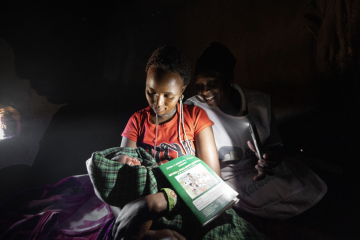
Samburu County, Kenya - In Lolmolong village, in Samburu County in northern Kenya, Neshoo Leaungokiok laboured through the night, far from the nearest health facility.
With no transport available and a six-hour journey on foot to reach care, she had no choice but to give birth at home, assisted only by a traditional birth attendant. In this remote part of Kenya, long distances, difficult terrain and insecurity continue to limit access to skilled care during childbirth, placing mothers and newborns at significant risk.
But this time, help arrived.
As labour intensified, Lucy Makena, a reproductive health officer from a nearby mobile outreach clinic supported by World Health Organization (WHO), reached the home. These clinics operate from off-road trucks fitted with a consultation room, patient beds, a small laboratory, and a pharmacy, designed to bring essential care directly to communities far from any permanent facility. Trained in emergency obstetric and newborn care through programmes also supported by WHO, she quickly assessed Leaungokiok’s condition and began monitoring the progress of labour.
“I found her already in active labour” Makena recalls. “I stayed with her, monitored her progress closely and supported the delivery.”
Makena’s presence came at a critical moment. In settings where complications can go unrecognized and timely care is often out of reach, skilled support can mean the difference between life and death.
With Makena’s support and care, Leaungokiok safely delivered a healthy baby girl.
Shortly after birth, however, Leaungokiok began to bleed heavily, a potentially life-threatening complication if not managed quickly. Acting immediately, Lucy administered lifesaving medicine to control the bleeding. She also supported the mother to initiate breastfeeding within the first hour, an essential step in protecting the newborn’s health.
“The baby is feeding well now. I am grateful to have delivered safely and to have a healthy baby,” says Leaungokiok, cradling her daughter.
For Makena, moments like this reflect the importance of reaching women wherever they are.
“In many of these communities, there may be no doctor nearby” she explains. “The training we receive helps us to act quickly, manage complications and support mothers safely through delivery.”
Through collaboration with county health authorities, WHO is supporting the expansion of emergency obstetric and newborn care services in northern Kenya, including training health workers and strengthening outreach services to reach remote communities.
In the past year, WHO has supported 14 of the 47 counties in Kenya to develop a pool of facility-based mentors of emergency obstetric and newborn care, helping ensure that more women can access skilled care during pregnancy and childbirth, even in the most hard-to-reach areas. While access to skilled birth care remains limited in some parts of the African Region, targeted investments in health workforce training and service delivery are helping to close the gap, as in Leaungokiok’s case.
Click image to enlarge For Additional Information or to Request Interviews, Please contact: Genna PrintCommunication officer
WHO Kenya
Tel: +254 740 466 426
Email: printg [at] who.int (printg[at]who[dot]int)
