If you get Global News from Instagram or Facebook - that will be changing. Find out how you can still connect with us.
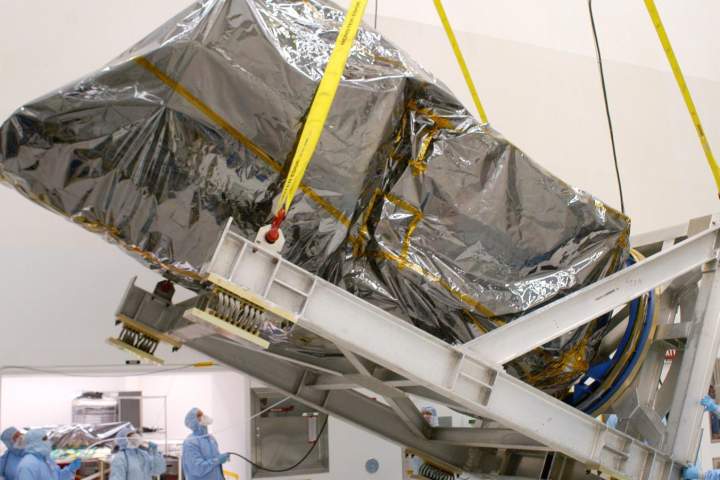
View image in full screen This photo provided by NASA shows an overhead crane raising the Swift spacecraft, wrapped in a protective cover, to vertical before being placed on a work standInside at Hangar AE at Cape Canaveral Air Force Station, in Florida on Sept. 9, 2002. (NASA via AP). NASA via AP PhotoCAPE CANAVERAL, Fla. (AP) — An aging NASA telescope is barely clinging to space after a failed rescue effort left it tottering lower and lower.
The U.S. Space Force predicts the Swift Observatory will come crashing down on or around Friday.
Most of the 1 1/2-ton telescope is expected to burn up in the atmosphere. But a handful of pieces made of denser-than-lead tungsten and some mirror parts could survive reentry, according to NASA’s Brad Cenko, the mission’s chief scientist.
Any surviving wreckage will most likely plunge into the ocean. But swaths of Africa, Australia, India, Southeast Asia, and Central and South America are within the reentry zone. The Space Force is tracking the telescope’s dwindling path.
Its cosmic cremation has the Swift team mourning yet full of gratitude for the observations the telescope made during its 22 years in orbit. Swift blasted off on Nov. 20, 2004, to search for some of the biggest explosions in the universe: gamma ray bursts and supernovas.
“We’ve known this day would come since before Swift was launched. At least in low-Earth orbit, what goes up must come down. And that end is catastrophic,” said Pennsylvania State University’s John Nousek, an astronomer who led the control team.
Get breaking National news
Get breaking Canada news delivered to your inbox as it happens so you won't miss a trending story. By providing your email address, you have read and agree to Global News' Terms and Conditions and Privacy Policy.Intense solar activity over the past few years dragged Swift down faster than usual. NASA hired Katalyst Space a year ago to mount a rush rescue. But the company’s three-armed robot named Link ran into trouble after launching in July and got no closer than 7 miles to 9 miles (12 kilometers to 15 kilometers) to the telescope. Link plunged back to Earth in September.
- Jeremy Hansen tapped by Carney as special adviser to feds on space
- Saskatchewan skies: Catching the Orionid meteor shower
- Envoy says France admires Carney’s U.S. stance
- University of Alberta researchers find evidence raptor may have fed on apex predator
Swift resumed observations once the rescue attempt was called off, discovering even more gamma ray bursts and other ultrahigh-energy events. But by late October, the telescope was too low to remain steady for observations, and its systems were shut down.
Its final tally: more than 2,000 gamma ray bursts and 1,400 exploding stars, not to mention a slew of comets, asteroids and star-shredding black holes. The telescope’s superpower was its ability to swivel swiftly — thus its name — toward erupting celestial events.
NASA considered Swift a first responder for the Hubble and Webb space telescopes and others that would follow its alerts and provide deeper investigations. Scientists are still figuring out how to fill the gap.
“Our fervent hope is that the lessons learned by the successes of Swift can be applied to new generations of space missions to accelerate our discoveries about the universe,” Nousek said in an email.
Add Global News as a Preferred Source on Google to see more of our stories in your search results.
Journalistic standards Report an error © 2026 The Canadian Press