- Published7 hours ago
Nato, the cornerstone of Western nations' defence, is stronger than ever. That's according to its Secretary General Mark Rutte who was speaking to the BBC at the alliance's summit in Ankara.
This despite some inflammatory words from Donald Trump who said how disappointed he was that Nato did not join in his war with Iran. (NATO was not consulted but in the end several countries, including the UK, let US forces use their bases to launch strikes on Iranian missile sites).
I put it to Rutte that there was a clear gap between the upbeat words of Nato officials and ministers on the one hand and the sometimes divisive comments made by the US president on the other.
Trump repeated his view that the US should take control of Greenland and he called Spain "a terrible partner", though he also stressed there had been "unification" at the leaders' meeting in Ankara - and that there had been "tremendous love in that room".
"It's a bit like in a family, you have families where you never quarrel and then it bursts out completely," says Mark Rutte, a suave and eloquent politician who served as prime minister of the Netherlands two years ago.
"Trump," he continues, "is completely committed to Nato.
Really? What makes him so sure? After all, this is a president who has indicated in the past that pulling the US out of Nato was "beyond consideration". Here in Ankara he repeated his assertion that the US had got a poor return from "the trillions" of dollars it had invested in Nato.
"I am 100% convinced [Trump is committed to Nato]," says Rutte. "Because… I know that the United States, this president included, particularly this president, also understands that - take [US Operation] Epic Fury [against Iran], it could not have taken place at this extent without using Europe as a power projection platform.
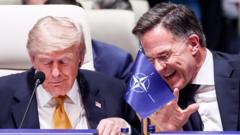
Image source, EPAImage caption,Rutte (L) says he is "100% convinced" that Trump is committed to Nato
"Five thousand planes taking off from European bases based on bilateral basing agreements in the first, in the six weeks between end of February and mid-April, till a ceasefire came into force."
With Nato's Nordic countries uncomfortably close to Russia's massive cluster of nuclear-armed submarine bases in the Kola Peninsula on Russia's Arctic coast, Rutte points out that it acts as a kind of early warning system for Washington.
"You don't want the Russian nuclear submarines to end up at the shores of the United States" he says. "We prevent that as Nato collectively. So, for all these reasons, we are in this together, 32 countries and nations, because we need each other."
This Nato summit was, despite the occasional distraction, largely about turning European governments' pledges of more money for defence into concrete action.
The aim is to galvanise the continent's industrial capacity to the point where it can match the threat posed by Russia's vast arsenal of drones, cruise and ballistic missiles.
While some countries, such as Britain, have failed to set out a pathway to spending 3% of GDP on defence by 2030, Rutte is clearly pleased with the increases achieved since the last summit in his home city, The Hague, in 2025.
"Today we took stock," he tells me, "and a quarter of a trillion [dollars] extra spent by Canadians and Europeans in two years. It's staggering. So we are delivering, and now we have to ramp up the defence industrial production even further, making progress and maintaining support for Ukraine."
So is he confident, I ask, that if Russia were to make a land grab somewhere, for example Estonia, in 2030 as some are predicting, that Nato would be ready?
Again, his confidence is convincing. It's a question he has probably been asked many times.
"Absolutely we'll be ready" he replies. "Now we're ready, in 2030 we are ready, at any moment. We are defensive. We will never attack another country, but every adversary knows that if they will try to attack us, we are ready. We will defend ourselves."