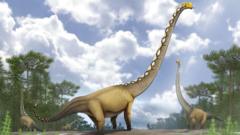
Artwork by Pakorn Chotchaiyaporn
ByAmy Walker- Published47 minutes ago
Palaeontologists in Thailand say they have discovered a new species of dinosaur from fossils found in Kalasin Province in the country's north-east.
The plant-eating dinosaur, named Uragasaurus kalasinensis, is thought to have lived about 150 million years ago.
It had an unusually long neck and measured up to 20m (66ft) - roughly the length of a cricket pitch.
Dr Apirat Nilphanaphan from Thailand's Mahasarakham University, the study's lead author, told BBC Thai that the specimen was part of a large fossil collection from a site first identified in 2008, when a local man found fragments resembling serpent scales.
The site where the discovery was made, Phu Noi, contained a wide variety of fossils from the Late Jurassic period. More than 90% of the fossils excavated from the site were dinosaur fragments.
When the survey team went to explore the site it found other fossils such as dinosaur teeth and bones.
However, the fossil that led to the discovery of the new species was a recovered dorsal vertebra — a bone from the middle or upper back — which showed distinctive characteristics.
A CT scan revealed that the dinosaur belonged to the Mamenchisauridae family of sauropod dinosaurs, characterised by their extremely long necks, which likely helped them reach vegetation at different heights.
While most fossils from the Mamenchisauridae family have been found in China, this discovery is the first of its kind in Thailand.
The scan also revealed unique characteristics, including a Y-shaped arrangement of supporting bones known as laminae.
Niphanaphan told BBC Thai the features, in particular a unique air-cavity structure, were "unlike any other dinosaur in the world... That's what sets it apart".
He said he smashed his keyboard after realising they had discovered a new species, adding that he felt both "exhilarated and relieved".
The study was published in the Nature scientific journal earlier this week.
In May, it was revealed that a different type of long-necked herbivore dinosaur - the nagatitan - had been identified by scientists from remains dug up in Thailand.
The nagatitan is the largest-ever dinosaur found in South-East Asia, weighing 27 tonnes - as much as nine adult Asian elephants - and measured 27m (88ft) in length.
Additional reporting by Jiraporn Srijaem