If you get Global News from Instagram or Facebook - that will be changing. Find out how you can still connect with us.
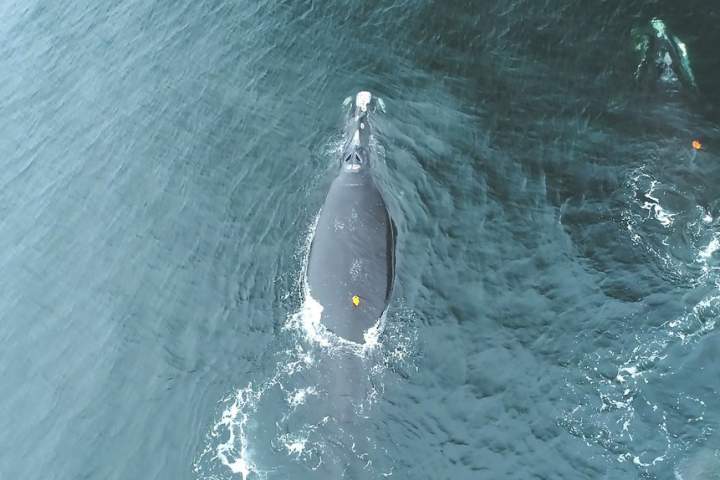
View image in full screen A tagged North Atlantic right whale in the Gulf of St. Lawrence is shown in this handout photo provided by Jay Kirkham, a PhD student at Dalhousie University. THE CANADIAN PRESS/Handout-Jay Kirkham (Mandatory credit)A recent study has found that critically endangered North Atlantic right whales are feeding closer to the ocean’s surface at night, increasing their risk of being struck by boats.
The study, published earlier this month in the peer-reviewed journal PLOS One, documented nighttime surface feeding in North Atlantic right whales, providing new evidence that could be used to prevent deadly collisions between the whales and vessels.
The paper’s lead author, Jay Kirkham, a PhD student at Dalhousie University in Halifax, said the research team worked with U.S.-based non-profit Ocean Alliance to tag 23 right whales in the Shediac Valley, an underwater valley in the southern Gulf of St. Lawrence.
A portion of the North Atlantic right whale population, which is estimated to be approximately 384 whales, gathers to feed in the Shediac Valley each summer.
Kirkham said the tags recorded video footage along with data on how the whales moved and in which direction they swam.
He said he used video footage to record right whale feeding behaviour during the day.
“When a right whale opens its mouth, it’s kind of like a big parachute opening on the front of their face … and that just slows them down an awful lot,” he said. “And so, they have to work harder, which they do by kicking their tail higher and faster.”
Get breaking National news
Get breaking Canada news delivered to your inbox as it happens so you won't miss a trending story. By providing your email address, you have read and agree to Global News' Terms and Conditions and Privacy Policy.Kirkham said he used these observations to train a machine learning algorithm that could recognize a right whale feeding at night when he was unable to visually identify the behaviour.
This data revealed that whales are feeding within the same depth as large vessels at night, increasing the risk of collision, he said.
2:00 Slow but steady growth in population of North Atlantic right whalesWhile right whales typically feed close to the seafloor during the day, Kirkham said the whales follow their food — zooplankton — higher up in the water column at night.
“These big ships that go through the gulf, they extend into the water maybe 10, maybe 15 metres,” he said. “The whales are in a sort of vertical overlap with that.”
- ‘We control who and where’: Province at odds with municipalities over AI data centres
- Raccoon euthanized after leg caught in trap in Langley
- High levels of lead found in air near Kahnawake high school in Quebec
- Petition launched to end activity at ECCO landfill in southeast Calgary
He said collisions with vessels and entanglements in fishing gear are the leading causes of death in the population and this study may help inform conservation measures for the whales.
Transport Canada and Fisheries and Oceans Canada currently oversee protection measures for the population.
In a statement to The Canadian Press, Fisheries and Oceans Canada said its measures focus on preventing whale entanglements in fishing gear and enforcing seasonal fishing closures.
The department said the study can help it develop “tailored management measures to protect North Atlantic right whales.”
Transport Canada implements speed restrictions and enforces a vessel exclusion zone in the Shediac Valley during the summer to reduce the risk of collisions between boats and right whales in the area.
However, Kirkham said that the whales he and his team tagged spent approximately 25 per cent of their feeding time outside of the vessel exclusion zone, exposing them to ship traffic.
In a statement to The Canadian Press, Transport Canada said it has a right whale surveillance program to help protect the whales from collisions by using both visual and audio detection tools.
“Acoustic monitoring systems and other complementary technologies can support whale detection regardless of daylight conditions and help inform protective measures when whales are present,” the statement said.
The department also said it uses the latest scientific research, monitoring data and feedback from stakeholders to inform its protection measures.
Add Global News as a Preferred Source on Google to see more of our stories in your search results.
Journalistic standards Report an error © 2026 The Canadian Press