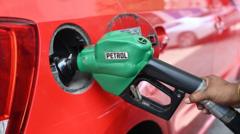
Oil prices have fallen sharply and Asian stock markets have risen on hopes of a deal that could bring an end to the US-Israel war with Iran.
On Saturday, US President Donald Trump said an agreement with Tehran had been "largely negotiated" and details would be announced soon but the following day urged his negotiating team not to rush a deal.
On Monday in Asia, global oil benchmark Brent was down by 5.5% at $97.90 (£72.64), while US-traded crude was 5.9% lower at $90.93.
Trump had previously said the deal would include the reopening of the key Strait of Hormuz shipping route, without giving further details.
The narrow waterway, through which around a fifth of the world's oil and liquefied natural gas (LNG) usually passes, has been effectively closed since the conflict started on 28 February.
The Nikkei 225 stock index in Japan rose above 65,000 for the first time after gaining 3% on hopes that the strait would soon reopen.
Japan, like nearby South Korea, has been particularly impacted by the conflict as they are heavily reliant on energy from the Gulf.
UK and US energy and financial markets are closed on Monday for public holidays.
Trump said on social media on Saturday that he had a "very good call" with the leaders of Saudi Arabia, the United Arab Emirates, Qatar, and others about a "Memorandum of Understanding pertaining to PEACE".
"An agreement has been largely negotiated, subject to finalization between the United States of America, the Islamic Republic of Iran, and the various other Countries, as listed," Trump said.
"Final aspects and details of the deal are currently being discussed, and will be announced shortly."
He also said he had a call on Saturday with Israeli Prime Minister Benjamin Netanyahu, which "went very well".
The president did not give any further details on the deal, but has insisted any agreement would "absolutely" prevent Iran from obtaining a nuclear weapon.
But on Sunday, he said on Truth Social: "Both sides must take their time and get it right. There can be no mistakes!"
Iranian foreign ministry spokesman Esmaeil Baqaei earlier told state television that US and Iranian positions had been converging in the last week, but warned that did not mean agreements would be reached on key issues and accused the Americans of "contradictory statements".
Global energy markets have seen big price swings since early March after Iran threatened to attack ships trying to use the Strait of Hormuz in retaliation for US and Israeli attacks on the country.
While crude oil prices have fallen sharply today they remain significantly higher than before the war.
In the lead up to the conflict Brent was trading at around $70 a barrel.
Tehran also attacked Israel and US-allied states in the Gulf, including Saudi Arabia, Bahrain and the United Arab Emirates.
A ceasefire was agreed in early April, and since then Washington and Tehran have engaged in talks over a long-term peace deal.
"There is now some light at the end of the tunnel, which will bring some near term oil price relief," Saul Kavonic, head of energy research at MST Financial.
"But even in the most optimistic scenario from here, oil markets will remain tight through 2027 given the time required to normalise oil flows through the Strait, repair damaged oil facilities, and rebuild global oil stocks that have seen record depletion since the war began," he added.
Donald TrumpOilInternational BusinessIran warRelatedTrump says Iran deal 'largely negotiated' including reopening Strait of Hormuz
Judge dismisses criminal case against Kilmar Abrego Garcia
Tulsi Gabbard to resign as US national intelligence director
More from the BBC2 hrs agoTrump tells US negotiators 'not to rush' into deal with Iran
2 hrs ago5 hrs agoHow Saudi Arabia's spending spree reached the end of the line
MBS's Vison 2030 project seemed the stuff of science fiction. Now reality has bitten
5 hrs ago7 hrs agoMorocco wants tourists to visit Western Sahara. Some say it's tightening its control
The Moroccan government wants more Western holidaymakers to visit the territory it claims to own.
7 hrs ago15 hrs agoOil firm wants to replace 'outdated' tanks
Millers Oils, a Brighouse-based oil blending and lubricants company, has been trading since 1877.
15 hrs ago1 day ago