If you get Global News from Instagram or Facebook - that will be changing. Find out how you can still connect with us.
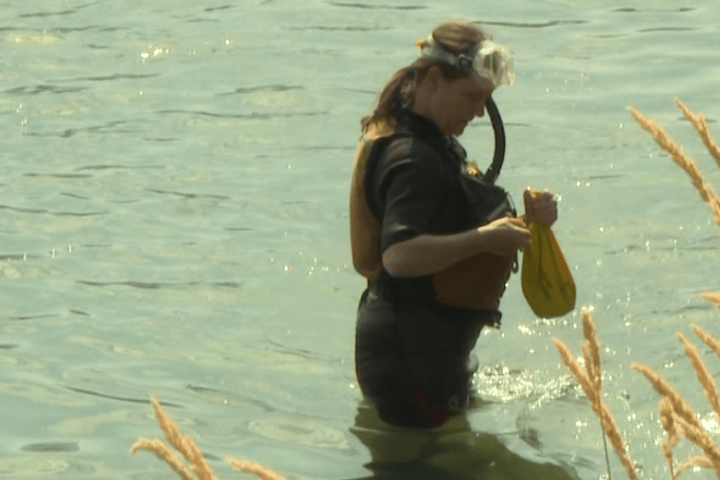
2:01 Working on Okanagan drought solutions With the Okanagan facing yet another summer of drought conditions, a specialized team is working on very long-term solutions. Cohan Sassaman reports.Researchers spent Tuesday waist-deep in streams near Okanagan Falls, searching for one of the smallest indicators of river health — mussels.
View image in full screen Zeo Eyjolfson, Fluvial Geomorphologist, explains that a high mussel count is a positive indicator of water quality because mussels filter particles from the water. Cohan Sassaman“Mussels are an indicator of water quality, so we are looking to put in more habitat that the mussels like,” said geomorphologist Zeo Eyjolfson.
As drought continues to strain the region, scientists are surveying mussels, fish habitat and river conditions to collect data that will help guide future restoration projects aimed at creating a more robust watershed and increasing biodiversity in areas that have lost multiple species.
View image in full screen Mussel species are just one of many being studied to determine which habitats are thriving and which will need to be improved before some species can return. Cohan SassamanThe work is part of a broader effort by the Collaborative Leadership Table (CLT), a partnership of First Nations and local governments developing a 250-year vision for managing water across the Okanagan.
Get breaking National news
Get breaking Canada news delivered to your inbox as it happens so you won't miss a trending story. By providing your email address, you have read and agree to Global News' Terms and Conditions and Privacy Policy.“Last year, the drought started in the valley and climbed up the mountains. This year, the drought seems to be all over, all at once,” said Chani Welch, a hydroscientist working with the initiative.
View image in full screen Chani Welch, Hydroscientist, explains that lower water levels cause rivers to warm more quickly, making it difficult for some fish species to survive the heat and preventing some salmon species from reaching their natural spawning grounds. Cohan Sassaman- B.C.-designed dive suit to be showcased at the Pentagon
- B.C. minister says TransLink must find way to transport HandyDART passenger
- Kelowna moves forward with plan to protect land for potential Highway 97 widening
- Saskatchewan says health-care recruitment plan paying off, opposition questions results
The information collected could help identify areas where rivers can be restored with more natural banks and habitat, improving biodiversity and creating healthier conditions for fish and other aquatic species.
Researchers say they have already found a stark contrast between the man-made channels near Okanagan Falls and sections of the river farther downstream, where natural embankments remain intact and support greater biodiversity.
“When you don’t have that natural biodiversity within a river and that natural river energy, you have a very homogeneous, dead river, and it’s pretty much just a hot bath for these species. A lot of them die” Eyjolfson said.
The research will help inform future decisions by municipalities, First Nations and the Collaborative Leadership Table as they work toward restoring waterways while balancing the needs of agriculture, ecosystems and communities.
“We need to get better at communicating that these decisions are being made with data. And it’s not just Western data, it’s also our Syilx community members who are telling us that we are in a severe drought,” Welch said.
For the researchers in the water, every measurement collected today is another piece of evidence that could help shape a healthier Okanagan watershed for generations to come.
Add Global News as a Preferred Source on Google to see more of our stories in your search results.
Journalistic standards Report an error © 2026 Global News, a division of Corus Entertainment Inc.