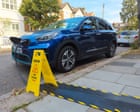
The energy secretary, Ed Miliband, has said charger gullies to connect electric cars parked on streets will help cut costs for drivers, yet millions of UK households may be unable to use the simple technology because their local councils will still not allow charging cables to cross the pavement.
Despite government promises to “slash red tape” and make it easier to put in gullies, more than 20 local authorities appear to be holding out against them.
They include the councils for Kent, Leicester, and Worcestershire, but the majority of the holdouts are in London including Westminster and Hackney. London has the highest number of electric cars in Britain and the highest number of households without off-street parking.
It is much more attractive to charge electric vehicles (EVs) via a domestic energy supply in part because of the VAT rate on the electricity used is 5%, compared with 20% when using a public charger. However, 9.3m households do not have access to off-street parking, according to the consultancy Field Dynamics, making it hard for them to access cheaper energy.
Gully makers including Kerbo Charge, Gul-e, Pavecross and ACO argue their products allow households to run a cable to their car parked on the street without creating a trip hazard. However, several councils said they had concerns about safety, parking and the aesthetics of cutting channels into pavements.
“It’s still going to require local authority approval before each installation,” said Michael Goulden, the co-founder of Kerbo Charge. The company is working with 48 local authorities that either allow gullies or are trialling them, but the situation is different with every council.
“We’re getting more and more streamlined with local authorities to make that more efficient,” Goulden added. Almost a fifth of 83 local authorities or combined authorities in England counted by the government did not apply for funding allocated to cross-pavement solutions, or did not take their full allocation.
“Many inner London boroughs have no plans to do cross-pavement right now,” said Goulden. “This change in the legislation [removing the need for planning permission] will make no difference to their residents in the near future.”
Reasons given by councils usually boil down to worrying who will maintain them and who will be liable if someone trips over a gully and hurts themselves. Guaranteeing a parking spot directly outside the home presents another problem.
Leicester city council said that for owners of its many terrace houses, it was not possible to always park in front of their property, and that the local authority worried about accessibility problems. Kent county council said it was also concerned about electric shock risk if cables were damaged. Worcestershire county council said it did not “permit the breaking or any damage to the highway to install an EV charger connection”, although it would allow cable protector ramps across the pavement.
Ealing council in west London said it had “accessibility and safety concerns, particularly for elderly residents, disabled people, wheelchair users and those with visual impairments”, adding that it was focusing on installing public chargers in lamp-posts.
In central London, Westminster council said gullies did not work in dense urban areas. Hackney council said it wanted to “minimise street clutter and prioritise vulnerable road users, such as people walking and wheeling over private vehicles” by keeping chargers off pavements and increasing its public charger rollout.
The government’s removal of the need for planning permission will help to speed up the process, but it still leaves installers needing street works licences, which are controlled by councils.
“They all have their different processes,” said Adam Dolphin, the director of Gul-e. “I wouldn’t say they’re an intentional barrier. They’re just working through the process, how it works.”
