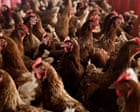
Organic eggs are twice as bad for the climate as eggs from chickens living in cages, research suggests.
According to the study, switching the UK’s entire egg production to an organic free-range model would lead to greenhouse gas emissions equivalent to 2,316,000 tonnes of CO2 (tCO2e), while production through a fully caged system would emit 1,184,000 tCO2e.
This is because organic free-range models need more chickens for the same number of eggs produced, as birds living in cages tend to be more efficient.
Organic free-range production also scored worst in its potential for water eutrophication, acidification and land use. Chicken mortality was also highest in organic free range farming, the researchers said.
However, the study used data from 2009-2010, which the researchers acknowledged as a limitation as it did not capture more recent developments in egg production. The research also did not take into account other environmental impacts such as pesticides or biodiversity.
Laying hens are the largest group of animals kept in cages across the world, and global egg consumption is going up, making their treatment an important welfare consideration, said Dr Harriet Bartlett, one of the authors of the study.
“I’d say perhaps it’s also a little bit of a blind spot when we talk about sustainability,” she added. “Meat and dairy get a bit more attention, talking about environmental sustainability, whereas [egg production] hasn’t been as researched.”
Bartlett is the senior research associate at Oxford University’s Smith School of Enterprise and the Environment, and has previously studied factory farming methods.
The latest study, published in Royal Society Open Science, involved Bartlett and colleagues examining data from UK poultry farms to calculate environmental impacts such as greenhouse gas emissions, land use and types of pollution. They also looked at welfare indicators such as mortality and the number of hens needed to produce a given number of eggs.
“Then we did we did some some modelling to work out these environmental and welfare outcomes,” she said.
“We found an important trade-off,” Bartlett added. “It’s that, the types of farms that are generally regarded as being better for animal welfare, like organic and free-range, can actually require more birds to produce the same amount of eggs because they’re less less efficient and they can have higher environmental impacts.”
skip past newsletter promotionFree newsletter | WeeklySign up to Down to Earth
The planet's most important stories. Get all the week's environment news - the good, the bad and the essential
after newsletter promotion
However, Bartlett said the research did not show the whole picture regarding factory farming. “Organic could come out better on pesticide toxicity, maybe biodiversity on farm as well,” she said.
Lee Holdstock, the head of regulatory and trade affairs at Soil Association Certification, who was not involved in the study, said the research “highlights some important trade-offs” but gave an “incomplete picture of environmental impact”.
“While intensive systems can have lower emissions per unit of output because birds use feed more efficiently, this reflects only one part of the picture,” Holdstock said. “A truly sustainable food system must also consider impacts on nature, soil health, water quality, the use of synthetic inputs, and animal welfare.”
The researchers estimated that 1,439,000 tCO2e is emitted under the current regime, in which egg production is split between caged, barn-housed, free-range non-organic and free-range organic systems.