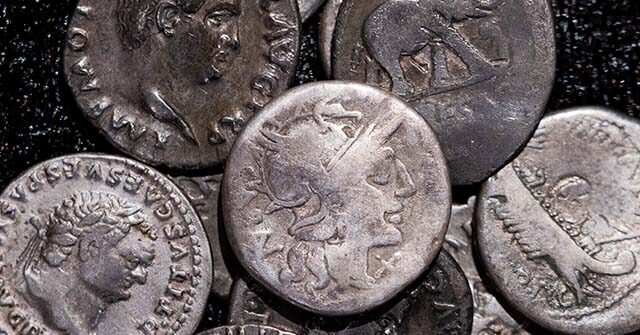
A metal detectorist made an incredible discovery in 2025 that dates back 2,000 years to the time of Roman Emperor Hadrian.
Oliver Riedl is a licensed metal detectorist who was using the device when he uncovered 934 Roman silver coins in a field near Wesseling, Germany, Fox News reported Sunday.
22 September 2026, North Rhine-Westphalia, Bonn: Roman coins are on display at the LVR State Museum. On an ordinary field near Wesseling, south of Cologne, Riedl, a family man, discovered a treasure from Roman times. He was using a metal detector there when he suddenly came across one silver coin after another. (Rolf Vennenbernd/picture alliance via Getty Images)
He suspected there were more coins under the dirt when the device kept beeping, and Riedl wasted no time in alerting authorities to what he had found.
Images showed the coins after they were cleaned up and polished. Some of the denarii feature portraits and birds:
Officials did not announce the discovery until recently and said it weighed over six pounds.
Popular Mechanics reported October 5:
According to a translated report from the museum, the oldest coin in the hoard was minted in 148 B.C.E. At the time it was buried, the then-270-year-old coin was still a valid form of currency. Most of the coins date to between 69 and 96 C.E. The most recent coin was minted in either 124 or 125 C.E., during the reign of Emperor Hadrian. “This makes it the largest coin hoard from this period in Germany and the fifth-largest worldwide,” said Erich Classen, director of the LVR-State Service for Archaeological Heritage.
According to Britannica, Hadrian was the ruler who “unified and consolidated Rome’s vast empire.”
Johannes Wienand, a professor of ancient history at the Technical University of Braunschweig, was not involved in the discovery but told Fox it was a “time capsule” of the money people used at that time and a Roman soldier would have needed several years to save the amount for retirement.
“The coins were discovered in a rural area near the Rhine frontier, which marked a border of the Roman Empire at the time, he noted. The Roman city of Cologne and a legionary fortress in Bonn were also nearby — raising the possibility of a military connection,” the Fox article stated.
The historical treasure is now on display at the LVR-LandesMuseum Bonn.
