More than a million people have had their faces scanned in a trial of real-time facial recognition technology in Western Australia, resulting in 122 arrests and nine incorrect alerts.
WA police said under the five-month trial, which concluded on Saturday, the technology scanned 1,380,882 faces after 100 deployments across 43 regional and metropolitan locations.
Alongside the 122 arrests, the alerts led officers to engage with 146 registered sex offenders and locate 10 people for a welfare check.
Disquiet grows in Albanese’s back yard as Grayndler artists unite against ‘insane’ AI proposalRead moreThe deployments included three operations at the Perth Royal Show, where 223,749 faces were scanned, resulting in 15 alerts, three arrests and seven “interactions” with registered sex offenders.
A police spokesperson confirmed the system generated nine incorrect alerts against the total 1.38m scans, meaning there was an error rate of 0.00065%.
Addressing the false matches at a media conference on Sunday, the WA police commissioner, Col Blanch, confirmed officers engaged with each individual.
“I want to be very clear on those false alerts,” he said. “No one was arrested. No one made a complaint. Each one did result in an interaction with that person and asking them relevant questions.
“It’s a very, very, very low number. It’s not zero. We’d love it to be zero. But I think the important thing for us is to engage with our community just like we would if a human thought someone was a wanted person.”
Blanch acknowledged the technology was “not perfect” and that authorities “knew this going into this trial”, but maintained that officers followed up on alerts in the same way they would if a member of the public raised suspicions.
Sign up for the Breaking News Australia emailHowever, civil liberties advocates have criticised how the WA police framed the error rate.
The chief executive of Civil Liberties Australia, Bill Rowlings, said WA police were “severely gilding the lily” by claiming the incorrect alert rate was 0.00065% and suggested it should instead be calculated by comparing how many of the arrests resulted in convictions.
“We will only know what the incorrect rate is when the 122 people arrested have their day in court,” he said.
skip past newsletter promotionFree newsletter |When neededSign up to Breaking News Australia
Get the most important news as it breaks
after newsletter promotion
“If half the 122 arrested … are not convicted, the ‘incorrect’ rate will be 50%,” he said in a statement, saying police had performed the almost 1.4m scans “with no reasonable suspicion whatsoever”.
When the trial was announced, the state’s independent privacy watchdog, the Office of the Information Commissioner WA (OIC WA), said it was not involved in implementing the trial, warning of “collective privacy harms” in a statement. The OIC WA was contacted for comment.
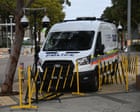
The police surveillance vans have now been removed from public deployment while the trial is evaluated. Photograph: Aaron Bunch/AAPOn Sunday, Blanch said the trial “focused on using modern technology responsibly to identify people who presented a risk, while allowing the vast majority of people to go about their day without any impact”.
Under the trial guidelines, cameras mounted on or positioned near marked police vehicles scanned faces in designated public areas, matching them against an alert list drawn from police databases. Police said images of people who weren’t on the list were pixelated in real time and deleted immediately without being stored.
The trial previously triggered backlash over concerns about privacy and algorithmic bias. Experts say the technology could disproportionately affect marginalised groups who are already overrepresented on police watchlists, with facial recognition algorithms historically having higher false-match rates for people with darker skin tones.
The surveillance vans have now been removed from public deployment while the force conducts an internal evaluation into how the technology performed on the ground and its community impacts, including “reviewing the safeguards and whether all requirements were met”.