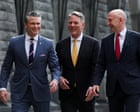
Senate estimates told it was a ‘joint idea’ to rework the nuclear submarine deal. Follow today’s news live
Get our breaking news email, free app or daily news podcast
- 9m agoGood morning
- 16m agoUniversity changed wifi terms to monitor for ‘breaches of policies’, report finds
- 27m agoAustralian troops will be sent to Poland to train with Ukrainians
- 35m agoAustralia always preferred used submarines, defence secretary claims
- 43m agoWelcome
Australia always preferred used submarines, defence secretary claims
Dan Jervis-BardyAustralia’s preference was always to receive secondhand nuclear powered submarines under the Aukus deal, defence officials have revealed, prompting the Coalition to question if the original arrangement was “imposed” on the Albanese government.
The defence secretary, Meghan Quinn, was grilled at Senate estimates on Tuesday night about the announcement that Australia would buy three used Virginia-class submarines from the US rather than a combination of new and old vessels.
Under questioning from the shadow defence minister, James Paterson, Quinn said it was a “joint idea” from Australia and the US to rework the deal.
Pressed on which country proposed the alternative plan first, Quinn said:
Australia’s position is that we would have always … had a preference for three in-service (submarines).
A surprised Paterson asked why the Albanese government accepted the original deal if that wasn’t its preference.
They imposed a new submarine on us and said you must take a new submarine even if you want three in-service?
Quinn replied:
ShareUpdated at 16.39 EDTKey eventsThis is a joint exercise over many decades, working collaboratively with an alliance partner to deliver a capability which is significant and is very important for Australia’s national defence. So there are many reasons why three in-service (submarines) would be simpler, lower-cost through the training of staff, the sustainment arrangements, the maintenance requirements, and all of those considerations.
- 9m agoGood morning
- 16m agoUniversity changed wifi terms to monitor for ‘breaches of policies’, report finds
- 27m agoAustralian troops will be sent to Poland to train with Ukrainians
- 35m agoAustralia always preferred used submarines, defence secretary claims
- 43m agoWelcome
‘Individuals will have their views’, Wong brushes off Husic’s Aukus call
The foreign minister, Penny Wong, has brushed off concerns from Labor MP Ed Husic, who has called for a rethink of the Aukus pact, and says the government still believes the deal with the US and the UK is the best course
Wong is in the hot seat this morning doing the media rounds, and she starts at the ABC’s News Breakfast.
She says the former Coalition governments kept “changing course on submarines” and left a capability gap in Australia’s defence force.
I understand individuals will have their views, but obviously I speak as a member of the cabinet and the government, and we believe it is in the best interests of our country for this project to continue to proceed … We believe chopping and changing will only set the country back.
Asked about the growing criticism within Labor’s inner and outer ranks – including former Labor MP Peter Garrett, Wong says that Labor is the “only political party that has an open debate in front of the media.”
ShareUpdated at 17.09 EDT9m ago17.02 EDTGood morning
Krishani DhanjiGood morning, Krishani Dhanji here with you for another busy sitting day – thanks to Martin Farrer for getting us started.
Debate on the government’s bill to change capital gains tax and the tax offset will continue today, with the opposition calling for the bill to be split. We’ll also be keeping a close eye on estimates – with Defence and the submarine agency set to front senators this morning.
The Solomon Islands prime minister, Matthew Wale, will attend parliament today for talks with Anthony Albanese. There are reports this morning from Nine newspapers that Albanese will use the time with the new prime minister to begin discussions on a treaty agreement and revive a policing deal.
There’s plenty happening so let’s get stuck in!
ShareUpdated at 17.11 EDT16m ago16.56 EDTUniversity changed wifi terms to monitor for ‘breaches of policies’, report finds
Caitlin CassidyThe University of Melbourne (UoM) changed its wifi terms of use allowing the network to be monitored by the university to help detect “suspected unlawful behaviour” or “breaches of university policies”, a new report into campus free speech has found.
The final report, released on Wednesday, was the result of a people’s inquiry into campus free speech on Palestine, initiated in 2025 by students and academics with support of the Greens. It had 150 written submissions and three public hearings.
An investigation found the UoM breached Victoria’s Privacy and Data Protection Act when it used its wifi network to surveil students and staff holding a pro-Palestine protest. It quietly introduced new terms of use in January, despite the state’s deputy information commissioner describing the surveillance as a “breach of trust”.
A spokesperson for the UoM said it was the university’s “responsibility to foster a secure and respectful environment, while upholding compliance with our policies”.
The wireless terms of use were revised after community feedback and reissued in January 2026 and now include more information on how wireless network data may be used.
The report found there had been widespread restrictions on free speech and academic freedom since pro-Palestine encampments were established in 2024, including disciplinary action, protest crackdowns and surveillance.
The Greens deputy leader and patron of the inquiry, senator Mehreen Faruqi, said the findings were “chilling”.
The harsh measures to silence dissent are quite reprehensible when universities should be upholding academic freedom and free speech.
Bart Shteinman, executive officer of the Jewish Council of Australia, which participated in the inquiry, said universities were facing a “rightwing culture war”.
ShareUpdated at 16.58 EDT27m ago16.45 EDTAustralian troops will be sent to Poland to train with Ukrainians
Dan Jervis-BardyAustralian troops will be sent to Poland in coming weeks to train Ukrainian soldiers in the latest effort to support its fight against Russia’s illegal invasion.
Australian Defence Force personnel have since January 2023 been based in the UK helping to train Ukrainian soldiers in basic infantry tactics, leadership and military skills.
But in coming weeks, the ADF personnel will be shifted to Poland as part of a Norwegian-led operation, bringing Australian troops closer to the conflict zone.
Making the announcement last night, the defence minister, Richard Marles, said:
Australia is continuing to adapt our contributions to Ukraine to ensure our support remains practical, relevant, and aligned with their most urgent needs.
ADF personnel trained more than 3,650 Ukrainians in the UK under Operation Kudu.
Since the start of Russia’s full-scale invasion in February 2022, the Australian government has provided more than $1.7bn in support for Ukraine, including $1.5bn in military assistance.
ShareUpdated at 16.52 EDT35m ago16.37 EDTAustralia always preferred used submarines, defence secretary claims
Dan Jervis-BardyAustralia’s preference was always to receive secondhand nuclear powered submarines under the Aukus deal, defence officials have revealed, prompting the Coalition to question if the original arrangement was “imposed” on the Albanese government.
The defence secretary, Meghan Quinn, was grilled at Senate estimates on Tuesday night about the announcement that Australia would buy three used Virginia-class submarines from the US rather than a combination of new and old vessels.
Under questioning from the shadow defence minister, James Paterson, Quinn said it was a “joint idea” from Australia and the US to rework the deal.
Pressed on which country proposed the alternative plan first, Quinn said:
Australia’s position is that we would have always … had a preference for three in-service (submarines).
A surprised Paterson asked why the Albanese government accepted the original deal if that wasn’t its preference.
They imposed a new submarine on us and said you must take a new submarine even if you want three in-service?
Quinn replied:
ShareUpdated at 16.39 EDT43m ago16.28 EDTThis is a joint exercise over many decades, working collaboratively with an alliance partner to deliver a capability which is significant and is very important for Australia’s national defence. So there are many reasons why three in-service (submarines) would be simpler, lower-cost through the training of staff, the sustainment arrangements, the maintenance requirements, and all of those considerations.
Welcome
Martin FarrerGood morning and welcome to our live politics blog. I’m Martin Farrer with the top overnight stories and then Krishani Dhanji will be your guide.
Australia’s preference was always to receive secondhand nuclear powered submarines under the Aukus deal, the defence secretary told Senate estimates last night. More coming up.
And Australia is going to send ADF troops to Poland to help train Ukrainian fighters. More on that, too, soon.
ShareExplore more on these topics- Australia news
- Australian politics
- Australian economy
- Business
- Health
- Australian education
- Australian immigration and asylum