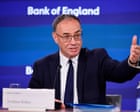
Bank of England governor says central bankers must explain decisions or risk being seen as ‘unrepresentative elite’
Heather StewartFri 4 Sep 2026 09.44 EDTLast modified on Fri 4 Sep 2026 10.11 EDTSharePrefer the Guardian on GoogleThe governor of the Bank of England has said the rise of populist politicians presents a serious challenge to independent central banks.
As Nigel Farage’s Reform UK gathered for its annual conference in Birmingham, Andrew Bailey said central bankers must be prepared to explain their decisions to the public or risk being attacked as an “unrepresentative elite”.
Bailey was speaking at a conference at the London School of Economics. In an address peppered with historical references, from Alexander Hamilton to Thomas Hobbes, he said central banks must not take their “legitimacy for granted”.
Bailey said populist parties’ pitch for power “often rests on the claim that a particular political movement alone represents the authentic will of the people. Any institution seen to get in the way becomes an unrepresentative elite standing between the people and their will, and thus an obstacle to popular sovereignty.”
He added: “This is a serious challenge. We have developed systems of government (in the broadest sense of this term) in which legitimacy rests in the plurality of society, not in the preferences of any single group within it.”
Populist parties, especially of the right, have been riding high on both sides of the Atlantic in recent years. Attacking traditional institutions – including central banks – often forms part of their platform.
Farage has previously suggested he would like to replace Bailey if Reform comes to power. In the US, Donald Trump repeatedly launched tirades against the former Federal Reserve chair Jerome Powell over the central bank’s failure to cut interest rates.
Nigel Farage has previously suggested he would like to replace Andrew Bailey if Reform came to power Photograph: Thomas Krych/APBailey was among the international central bankers who signed a joint statement defending Powell against Trump’s criticism and stressing the importance of independence.
The Bank of England was made independent by the Labour government in 1997, handing decisions on interest rates from the chancellor to a nine-member monetary policy committee (MPC) chaired by the governor.
After the 2008 global financial crisis, which led to a significant proportion of the UK banking sector being nationalised at taxpayer expense, the Bank of England was given additional responsibilities for financial stability.
Bailey said on Friday that insulating the Bank from politics had made it better able to fulfil its role of maintaining “the monetary and financial conditions that make sustained prosperity possible”.
He said: “Institutions that exercise significant authority should expect scrutiny. Such scrutiny is a sign of democratic health. But we should also recognise what is at stake.”
skip past newsletter promotionFree newsletter | Every weekdaySign up to Business Today
Get set for the working day – we'll point you to all the business news and analysis you need every morning
after newsletter promotion
The MPC is split over how to respond to rising inflation as a result of the Iran war. Bailey has stressed that in a weak jobs market, he does not yet see signs of the “second-round effects” that can embed inflation throughout the economy as workers bid up their wages to keep pace.
The MPC voted to keep interest rates on hold at 3.75% at its last meeting in July. But three members voted for a rate rise, including the Bank’s hawkish chief economist, Huw Pill, who used a speech on Thursday to reiterate that in the face of rising inflation, Threadneedle Street should act “clearly, promptly and decisively”.
At its next policy meeting on 17 September, the Bank is also expected to announce whether it will press ahead with its controversial policy of quantitative tightening. The Bank has been progressively selling off the bonds it acquired though the emergency policy of quantitative easing – creating money to help stave off recession.
Critics, from Reform to leftwing thinktanks, have argued that these sales tend to drive up the yield, or interest rate, on government bonds, which move in the opposite direction to prices. That makes it more expensive for the government to borrow, a pressing issue at a time of febrile bond markets.
Bailey will appear before MPs on the cross-party Treasury select committee next week to explain his thinking.
Explore more on these topicsShareReuse this contentRising oil prices could force up UK interest rates, say economists
26 Jul 2026How Burnham’s team could reshape the Bank of England
17 Jul 2026Bank of England handed powers to regulate key tech firms including Amazon and Google
10 Jul 2026Bank of England plans to ease capital rules despite AI stability fears
7 Jul 2026Bank of England warns of AI scams as deepfakes of Farage-Bailey fight spread
9 Jun 2026Bank of England’s Bailey says no rush to raise interest rates amid Iran war uncertainty
29 May 2026UK firms expect to raise prices more quickly as Iran war pushes up costs
2 Apr 2026Bank of England governor hits out at populism as Trump interferes in US Fed
16 Jan 2026Deep in the vaults: the Bank of England’s £1.4bn Venezuelan gold conundrum
6 Jan 2026How many more times will the Bank of England rescue Rachel Reeves?
14 Dec 2025…… comments