Weirs, culverts and sluices among 602 barriers demolished in year in attempt to restore 15,500 miles of rivers by 2030
Ajit NiranjanThu 21 May 2026 08.14 EDTLast modified on Thu 21 May 2026 08.52 EDTSharePrefer the Guardian on GoogleA few miles downstream from a lava field in western Iceland, the gargle of free-flowing water is unbroken for the first time in decades after hydraulic peckers chipped away at a dilapidated dam that once powered a farm. The structure on the River Melsá had continued to block fish migration long after falling into disrepair.
“It wasn’t providing any electricity; the old power house had sheep living in it,” said Hamish Moir, a river engineer from CBEC, a Scottish firm that provided technical support for the demolition in December. To see the river restored to its natural state was “really rewarding”, he said.
The dam was officially the first that Iceland has removed from its rivers, but across Europe a record-breaking 602 barriers were removed last year, according to new analysis. A report from Dam Removal Europe found that the number of dams, weirs, culverts and sluices dismantled grew by 11% from the year before, letting more waterways resume their natural course. It is part of a global trend to restore rivers to help wildlife thrive.
The 2,324 miles (3,740km) of rivers that were reconnected through barrier removals in 2025 brings the EU a step closer to its goal of restoring 15,500 miles to their natural state by 2030.
Chris Baker, the director of the European branch of Wetlands International, said: “For centuries, Europe treated rivers as engines for economic growth – damming them for mills and hydropower, straightening them for navigation, and burying them beneath cities. We built our prosperity by fragmenting our rivers, but the ecological price has been enormous.”
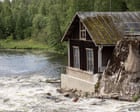
Rapids flow once again on the Hiitolanjoki River in Finland after the demolition of the Ritakoski Dam. Finland is second after Sweden for barrier removals. Photograph: Maija Koskinen/Maija Koskinen/AlamyRiver barrier removals have increased sixfold from the first official count in 2020, according to the report. It found that Iceland and North Macedonia took down barriers for the first time in 2025. Sweden led the way with 173 barrier removals, followed by Finland with 143 and Spain with 109. The UK has removed 35 barriers.
Dam Removal Europe is a coalition of environmental groups pushing to make rivers and streams free-flowing once more. Its analysis found that more than three-quarters of the barriers removed in 2025 were less than 2 metres tall. Such structures, many of which no longer serve their original purpose, are relatively cheap and easy to remove.
The damming of rivers disrupts ecosystems, hinders the transport of sediments and is thought to have contributed to a 75% decline in the continent’s freshwater migratory fish population since 1970. Rivers reconnected last year include the Kriva and Pčinja rivers in North Macedonia, a first for the small Balkan nation, while in Norway an obsolete 6-metre-high dam on the Vinstra River was dynamited.
Restoring rivers to their natural state helps wildlife thrive, though researchers caution that it can also present new risks. A study last year found artificial barriers could slow the spread of invasive species, presenting a “connectivity conundrum” in which barrier removals may allow new threats to travel from one part of a river to another.
Ellen Donovan, a biologist at Queen’s University Belfast and lead author of the study, said: “While initial improvements in connectivity can be rapid, stressors such as invasive species can eventually accumulate and erode longer-term conservation value. With careful preparation, monitoring and long-term management, these risks can be minimised.”
More than a million barriers break up Europe’s waterways, with tens of thousands thought to be obsolete. The EU’s nature restoration law, which entered into force in 2024, explicitly calls for their removal so rivers and lakes can be reconnected.
In the US, where streams are fragmented by more than 550,000 dams and 300,000 road-related barriers, an estimated 70% of dams have outlived the average design life. According to data from American Rivers, a nonprofit, 100 dams were dismantled in the US last year. Conservation efforts in China have resulted in the removal of hundreds of dams on the Yangtze River in recent years.
Baker said: “People increasingly understand that obsolete dams are not monuments that must stay for ever. Many are simply ageing industrial relics causing ongoing ecological damage.”
Explore more on these topicsShareReuse this contentIndustrial chicken producer hits out over Wye and Usk river pollution claim
27 Apr 2026Thousands take legal action over ‘widespread pollution’ of three UK rivers
8 Oct 2025Feargal Sharkey accuses Environment Agency of illegally draining River Lea
18 Aug 2025Council recognises right of River Test to flow unimpeded and unpolluted
30 Jul 2025Low water levels push up shipping costs on Europe’s rivers amid heatwave
7 Jul 2025England’s rivers ‘under threat’ as water extraction surges to record levels
20 Jun 2025Poultry megafarm in Shropshire halted over river pollution concerns
17 Jun 2025Environment secretary’s appeal against Yorkshire river pollution ruling fails
2 Apr 2025