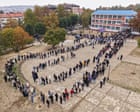
The Student List movement is taking on authoritarian leader following nearly two years of protests against government and institutional corruption
LIVE Updated 18s agoJakub KrupaSun 25 Oct 2026 12.42 EDTFirst published on Sun 25 Oct 2026 12.02 EDTShareKey events- nowHow did the student movement come about?
- 11m agoWho are the main actors tonight?
- 27m agoWho is Aleksandar Vučić?
- 40m agoBlog opening: Serbia's strongman Vučić faces sternest test of his 12-year rule
- nowHow did the student movement come about?
- 11m agoWho are the main actors tonight?
- 27m agoWho is Aleksandar Vučić?
- 40m agoBlog opening: Serbia's strongman Vučić faces sternest test of his 12-year rule
How did the student movement come about?
The roots of the student movement trace back to the 2024 Novi Sad disaster, where 16 people were killed after an outdoor concrete canopy collapsed at a train station in Serbia’s second largest city.
Rescue service workers inspect a scene as a roof collapsed at a railway station in Novi Sad, Serbia. Photograph: Interior Ministry of Serbia/APInquiries into the causes of the incident revealed slipshod construction along with allegations of fraud and corruption, prompting relentless mass protests demanding transparency and accountability about the incident.
‘We are done with corruption’: how the students of Serbia rose up against the system Read moreA protester faces with a Serbia's police officer showing red painted hands symbolising government neglect and mismanagement calls for the resignation of the Minister of Construction in Belgrade. Photograph: Andrej Isaković/AFP/Getty ImagesStudents and anti-government demonstrators light the flashlights of their mobile phones during a protest in March 2025. Photograph: Igor Pavicevic/ReutersThe demonstrations – primarily organised by students – were frequently met with violence, persecution and extensive surveillance by the authorities, with Vučić repeatedly floating unsubstantiated claims of foreign interference.
When Belgrade students blocked a road in a vigil for the victims three weeks after the disaster, they were attacked by a pro-government mob and the protest movement went nationwide.
Serbian riot police clashes with anti-government protesters in Belgrade in August 2025. Photograph: Marko Djokovic/AFP/Getty ImagesThe student movement eventually morphed into a more political – but not partisan - one.
As Julian Borger noted recently,
A student protest movement has gripped Serbia for two years. This weekend it will try to take powerRead more“Unable to crush the students by force, division or denigration, Vučić gambled, announcing his resignation as president and calling snap elections, in the apparent hope of catching the students off guard, but they responded by improvising a democratic experiment.
The 250 candidates were mostly nominated by university faculties (there are more than 160 doctorates among them) with a sprinkling of farmers and other professions, and each candidate was subject to approval by plenary sessions of the student protests.”
In a highly unusual development, however, the group has remained decentralised. For starters, in sharp contrast with Péter Magyar’s Tisza in Hungary, it has no single leader.
A gen Z protest movement could be about to oust Serbia’s strongman. Here’s why that will shake Europe | Misha GlennyRead more56-year-old cardiologist Ilija Srdanović appears at the top of the ballot, but it is far from obvious if he would be the first pick as a potential future PM.
Instead, the movement focuses on big collective efforts, with large-scale marches across the country and door to door canvassing, including deep in Vučić’s base of rural voters and among typically sidelined minorities.
‘We’ve proved that change is possible’ – but Serbia protesters unsure of next moveRead moreIt remains to be seen how effective – and disciplined – they would be if they actually succeeded in getting into government. Rewiring the state with all its deeply embedded structural issues after more than a decade of increasingly authoritarian rule would no doubt pose numerous challenges.
As they mount a challenge against Vučić, the students appear to sometimes play on some of the themes of his rule to appeal to his disillusioned voters. Their political manifesto is very carefully constructed to tiptoe around the trickiest issues, particularly in foreign policy, including on Russia and the EU. But eventually they would have to face them head on.
Ivan Đurić of the Center for Research, Transparency and Accountability (CRTA) notes that the students adopted lots of national symbols – including heavy use of flags and the historically-controversial three-finger sign to now denote their number on the electoral ballot – in their rhetoric, but stresses they gave them “a new meaning.”
Supporters of Serbia's student-led movement attend the final campaign rally of the student-backed election list in central Belgrade this week. Photograph: Andrej Isaković/AFP/Getty ImagesSupporters of Serbia's student-led movement attend the final campaign rally of the student-backed election list in central Belgrade. Photograph: Mitar Mitrović/AFP/Getty Images“Before student movement, if you saw 100 Serbian flags on a protest, you would [think these are] some extreme nationalists, which is also not normal …
But they have shifted the paradigm in this sense … and after years of nationalistic propaganda, it is impossible to expect some kind of extremely liberal, completely pro-European, anti-Russian, peace-making party will get 40%. Not a chance.
But the people who are on this list, … you can imagine them at a table with any partner in the region.”
Marta Szpala of the Polish Academy of Science and BiEPAG research group goes further and contrasts the Serbian model with disruptive and often violent protests movements in western Europe.
Share11m ago12.31 EDT“[The Student List shows] an alternative model: a protest movement that has sustained mobilisation for two years, built a genuine political alternative, and established oversight of its electoral process, standing a chance of bringing about real change.
Serbia may be about to show that achieving change simply requires consistency, perseverance, and the building of broad-based alliances.”
Who are the main actors tonight?
Jon HenleyEurope correspondent
Aleksandar Vučić’s SNS anchors the “United Serbia” list. The party relies on control of the public purse, favourable media coverage and strong nationalist backing, but its campaign has been overshadowed by accusations of systemic voter manipulation.
People walk on a bridge with a huge poster of Serbia's former President and the ruling Serbian Progressive Party (SNS) candidate for prime minister Aleksandar Vučić on it, in Niš, Serbia. Photograph: Marko Đurica/ReutersThe Student List eschews party hierarchies or a single figurehead, preferring locally respected academics and professionals, and operates through university networks. Its quickfire, humorous campaign has mobilised large numbers of disengaged voters.
Supporters of Serbia's student-led movement attend the final campaign rally of the student-backed election list in central Belgrade. Photograph: Sava Miric/AFP/Getty ImagesThat means Serbia’s traditional opposition parties have been largely marginalised, with their collective support falling from 30% to 10-15%. Some parties have switched allegiance to the Student List. Others, such as European Serbia, may not clear the 3% electoral threshold.
Meanwhile, Serbia’s rightwing, nationalist bloc is riven with disagreements and has been further weakened by the unexpected withdrawal of the We the Power of the People party over allegations of Russian influence. Some of the nationalist vote may switch to the SNS.
What is at stake in Serbia’s election? The key players, main issues and potential falloutRead moreShare27m ago12.14 EDTWho is Aleksandar Vučić?
Serbia’s former president and now prime ministerial candidate (again) Aleksandar Vučić rose to prominence in the 1990s as a radical nationalist, who supported the policies of Serbian expansion and ethnic cleansing led by Slobodan Milošević, who died of a heart attack in detention in The Hague during his trial on charges of genocide and crimes against humanity committed in Croatia, Bosnia and Kosovo.
Serbia's former president and the ruling Serbian Progressive Party (SNS) prime ministerial candidate Aleksandar Vučić speaks to the media during the parliamentary election in Belgrade, Serbia. Photograph: Marko Đurica/ReutersHe served as Milošević’s information minister throughout the Kosovo conflict. His Serbian Progressive Party, or SNS, has been in government since 2012.
He first spent three years as the prime minister from 2014, before switching to the role of the president in 2017. Unable to run for the third term, he resigned from the post in September, and now wants to lead the government again.
As president, Vučić has not emulated his predecessor’s militarism, but he has maintained his nationalist playbook in domestic politics, dismissing the opposition as stooges of unspecified foreign powers.
He maintains close ties with Putin’s Russia and Xi’s China, which regularly gets him criticism from the EU and complicates Serbia’s path to the bloc.
Russian president Vladimir Putin meets with his Serbian counterpart Aleksandar Vučić in Sochi in November 2021. Photograph: Mikhail Klimentyev/SPUTNIK/AFP/Getty ImagesSerbia has regressed in international rankings for press freedom and corruption in recent years, and its process of joining the EU is effectively stalled. More on that shortly.
Vučić is also fairly close with Donald Trump and his associates. He hosted Donald Trump Jr and Jared Kushner in Belgrade, and, as we revealed, personally intervened to advance an allegedly illegal – and definitely very controversial – scheme to hand over a protected site in Belgrade for a Trump tower.
Share40m ago12.02 EDTBlog opening: Serbia's strongman Vučić faces sternest test of his 12-year rule
Jakub KrupaDobro veče, or good evening, and welcome to our live coverage of Serbian election night.
People vote as Serbia holds parliamentary elections in Belgrade, Serbia. Photograph: Andrej Ivanov/Getty ImagesThe grassroots protest movement, the Student List, is taking on the country’s increasingly authoritarian leader, Aleksandar Vučić, in what is shaping up to be the sternest test of his 12-year grip on power.
The vote is a culmination of two years of student-led protests triggered by the collapse of the Novi Sad railway station canopy in November 2024, which killed 16 people and uncovered massive government and institutional corruption.
The bottom-up leaderless movement, with 250 candidates democratically elected from people with limited political experience but distinguished professional careers, seeks to end Vučić’s rule and rewire the state, with focus on fighting alleged corruption, clientelism and power abuses of the past.
Supporters of Serbia’s student-led movement attend the final campaign rally in central Belgrade on Thursday. Photograph: Andrej Isaković/AFP/Getty ImagesPolls opened at 7am (6am UK time) and close at 8pm (7pm UK time). Until then, we’ll bring you all the key background, explain why it matters for Europe, Ukraine, and you, and give you a flavour of the chatter in the queues outside polling stations from Belgrade to London.
What is at stake in Serbia’s election? The key players, main issues and potential falloutRead moreI will also keep one eye on the first round of the presidential election in Bulgaria, so expect an odd update on this or two on this.
Ready? Let’s go. Ajde.
It’s Sunday, 25 October 2026, it’s Jakub Krupa here, and this is Europe Live.
Good evening.
ShareExplore more on these topicsShareReuse this content