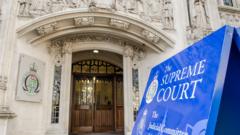
Severely disabled people aged 16 and over will now be able to give consent to their care arrangements despite not having the capacity to do so, the Supreme Court has ruled.
The judgement, which was triggered by a case brought by the Attorney General for Northern Ireland, will apply across the UK.
Northern Ireland Health Minister Mike Nesbitt had sought to change the code of practice on how people are deprived of their liberty if they lack the capacity to consent to care arrangements.
Charities including Mencap, Mind and the National Autistic Society have warned that the ruling "strips fundamental human rights protections from potentially hundreds of thousands of severely disabled people".
It is thought more than 9,000 people in Northern Ireland will be affected by the ruling, and any potential action by the health minister.
It also means other health departments across the UK could change their legal frameworks on care arrangements for those who are severely disabled.
Disabled 'have right to liberty'
Thousands of disabled people at risk from 'back door' law change, say charities
Many 'stuck in bed for days without care', Covid inquiry hears
What rules were in place before the judgement?
The ruling overrules a previous Supreme Court judgement ruling known as Cheshire West.
In that case, the court established an 'acid test' that if someone is under continuous supervision and control, is not free to leave and cannot consent to this, they are deprived of their liberty.
This usually applies to people with a severe learning disability or dementia, living in locked rehabilitation units or placements such as supported living or care homes.
However, Northern Ireland's health minister sought to change the code of practice so that a person can given valid consent, through the expression of their wishes and feelings, even if they lack relevant capacity.
These legal safeguards ensure an independent person checks that such arrangements are justified, lawful, and in the person's best interests.
However, the Supreme Court heard arguments that Cheshire West was wrongly decided and creates an unsustainable administrative burden on health and social care systems.
In written submissions on behalf of Northern Ireland's attorney general, Tony McGleenan KC said a wider definition for the code of practice would "mean that fewer people aged 16 and above with impaired decision-making capacity would be regarded as deprived of their liberty".
"Safeguards would still be required... but those safeguards would focus on identification of the person's known wishes and feelings," he added.
What does the Supreme Court ruling mean?
The ruling, which will also be applied in England, Wales, and Scotland, as well as Northern Ireland, has said that a multifactorial approach will now be used in determining whether someone is deprived of their liberty.
Significantly a person's own wishes and preferences will be taken into consideration, however, unless they indicate an objection, it's unlikely that their living arrangements will be considered a deprivation of liberty.
It could potentially prove challenging for those in charge of providing care, as the court has acknowledged that people's ability to express their attitude towards their care arrangement will vary from case to case.
Northern Ireland's health minister now has the legal power to revise the Deprivation of Liberty Safeguards (doLS) Code of Practice, which oversees care arrangements for people without sufficient mental capacity.
Getty ImagesIn a joint statement, Mencap, Mind and National Autistic Society said the ruling could make it "easier for abuse and neglect to go unnoticed behind closed doors"Ruling 'sets us back decades'
The judgement has been met with alarm by some charities.
In a joint statement, Mencap, Mind and National Autistic Society said it "sets us back decades", adding that it could make it "easier for abuse and neglect to go unnoticed behind closed doors".
"By removing independent checks, advocacy, and automatic access to legal aid, the Court has closed the gateway to justice and support for many who need it most.
"A litany of previous wrongdoings demonstrate how closed cultures, lack of independent oversight and restrictive care can lead to abuse scandals and decisions like this fly in the face of everything we've learnt."
Calling on the UK government to urgently issue interim guidance to health care providers, the charities said it should "urgently bring in new laws and guidance that strengthens protections for some of the people who are most at risk".
"This should include clearly explaining how disabled people and their families can challenge breaches of their rights and get the advocacy and support they need."
What does it mean to be mentally incapacitated?
Mental capacity refers to whether a person is able to make their own decisions.
It can cover everything from what clothes to wear to significant decisions such as whether to move into a care home. Some people may be able to make decisions on some things, but not others.
Determining that someone is mentally incapacitated is not a simple process, but people over 16 who fall into this category are protected under the Mental Capacity Act 2005.
The act is designed to protect and empower people who may lack the mental capacity to make their own decisions about their care and treatment.
According to the NHS, a person's mental capacity can change over time depending on their condition and what decisions need to be made.
Northern IrelandDisabilityUK Supreme CourtNI HealthSocial careRelatedDonaldson rape accuser says he apologised to her years later at a Christian centre
BBC Newsline signed summary
Multi-million pound takeover of NI firm could create hundreds of jobs
More from the BBC10 hrs ago'A heel prick test might have saved our seven-year-old son's life'
MLD is a rare metabolic disorder that leads to a progressive loss of physical and mental skills.
10 hrs ago2 days agoNature-loving disabled woman 'literally padlocked out' of favourite landscapes
Bethany Handley says design, not disability, makes green spaces inaccessible for people like her.
2 days ago3 days agoDisabled singer's 'unforgettable' moment on Michael McIntyre's Big Show
Ruthie O'Brien was born with a rare genetic condition which caused deafness.
3 days ago3 days ago'The real job is at home' - comedian describes life as an unpaid carer
Comedian Conor Keys balances life as a performer with full-time caring responsibilities.
3 days ago4 days agoFestival fans warned over 'pink powder' drugs
Health agencies on both sides of the Irish border issue a joint warning ahead of summer festivals.
4 days ago