A government in office for more than two years is finally forced to take responsibility and seemingly no longer able to blame its Labor predecessors
Get our daily political email, free app or daily news podcast
At the beginning of another Queensland parliamentary sitting week, anonymous sources were out in force, this time background briefing against the state’s Labor leader, Steven Miles.
It is no great revelation to observers of Queensland politics that Miles, still seemingly bruised from his election loss two years ago, has struggled to find his feet as opposition leader. Many wondered why he wanted to stay on after the party’s drubbing in 2024. Some of Labor’s factional whisperers were telling anyone who would listen that the former premier’s leadership would come to an end in the weeks before Christmas.
However, the week in parliament has ended with a revitalised opposition and a wounded LNP government. A government that has for so long seemed untouchable. A government that has now been left battling the perception that it is overseeing a broken health system.
Queensland government accused of using ‘threatening’ tactics to silence criticsRead moreAnd a government – now in office for more than two years – finally forced to take responsibility for systems it had promised to repair; seemingly no longer able to legitimately blame the former Labor government for the litany of mistakes that led to the deaths of seven people in the care of Queensland’s health system.
By the end of the week, parliament heard six people had died waiting for an ambulance in the last three weeks. One man had waited seven hours, another three. All were triaged as urgently in need of attention.
Another man had taken his own life in the emergency department of the Prince Charles hospital after self-admitting for mental health treatment. It took staff three hours to find him.
Sign up for Guardian Australia’s Politics, really newsletter here
The health minister, Tim Nicholls, is a professional, a 20-year veteran, with the bearing of a well-paid barrister, who led the LNP to an election in 2017.
But he struggled to cope with the parliamentary barrage.
In response to a question from Labor’s Joe Kelly, a former nurse, about how many ambulances had been ramped on 3 November, the night a man died while waiting for one in Townsville, Nicholls first criticised the question’s “pettiness”.
“What next? Are they going to ask me what the level of fuel was in the back of the ambulances?” he responded.
“There was no ramping overnight at the Townsville University hospital that night,” he finished.
But that was wrong.
“I am very pleased to be able to correct the record for the purposes of the house,” he said, two questions later.
“There were at that time four ambulances, as I understand it, on the ramp waiting to off-load. That was the situation there.”
Nicholls threw the blame at the federal government, at the former Labor state government and its “decade of decline”, a phrase repeated endlessly by government MPs, at overwhelmed hospitals full of “forgotten Australians”, a term used to refer to retirees warehoused in public hospitals for lack of a federally funded retirement home to put them in.
Endlessly, Labor hounded him: would he meet the families of the dead?
The answer was not quite no, but never yes either.
For a government built on a small-target strategy based on responding to the grief of victims of crime – predicated on the fact that any indecisive response to a tragedy would be an inherently unconvincing one – this was a completely different emotional battle.
By Wednesday, Nicholls was attending an emergency meeting with the premier, David Crisafulli, the health department director general, David Rosengren, and the ambulance service commissioner, Craig Emery.
The next day, after another bruising question time, he called a press conference.
Bearing his well-worn years-old folder labelled “LABOR’S HOSPITAL FAILURES”, he insisted that he was taking responsibility – for making sure his subordinates were doing their jobs.
skip past newsletter promotionFree newsletter |Every weekdaySign up to Politics, really
Our political team brings you up to speed on the stories that really matter and what they mean for you
after newsletter promotion
“I think people would expect that, as the minister, I hold the DG and the commissioner responsible for the services that they deliver, and I seek answers to questions,” he said.
“So I sought advice from the commissioner about the steps that they were taking, what was being done to address the need, what was the root cause of the problem.”
Nicholls said the community could have confidence in the triple-zero system and paramedics, promising to reinvest whatever it was he needed to, on advice from his department.
“Like all Queenslanders, I do have questions regarding the delivery of services because one death that’s unexpected in the community is one too many,” he said.
“Every available vehicle is on the road. But the issue is there are simply not enough beds.”
After 10 minutes, with many more questions unasked, he abruptly walked off, looking more like a traditional Queensland health minister than any in the LNP cabinet have this term.
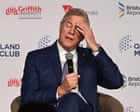
Steven Miles has lashed the LNP over ‘six, seven, maybe more preventable deaths’. Photograph: Darren England/AAPThen Miles stepped up to the microphone. After days of leadership speculation in newspapers – which has been deliberately and mischievously fanned by the government – the former health minister was on much more solid ground.
“I have never before seen so many preventable deaths of Queenslanders left waiting hours for an ambulance to arrive, only to die before it does,” Miles said.
“Six, seven, maybe more preventable deaths.
“It is only getting worse and worse. The worst that it’s ever been.”
Miles retains significant goodwill from most Labor MPs, but the polls have become hard for most to ignore. Some think he’s simply failed to land enough punches. Others that he hasn’t thrown nearly enough.
It remains to be seen whether Miles’s decision to come out swinging was the act of an opposition leader with nothing to lose, deciding to fight at five minutes to midnight in his political career.
One thing is certain. After two years in which the opposition has rarely felt relevant, this week Queensland politics finally felt like a fair fight.
Andrew Messenger is a state reporter in Guardian Australia’s Queensland office
Explore more on these topicsShareReuse this content‘I’m not a dangerous woman’: how retirees Sandra and Marlene became the faces of hate speech laws in Queensland
1d agoQueensland government accused of using ‘threatening’ tactics to silence critics
8 Nov 2026Less than half First Nations staff feel culturally safe at Queensland’s Indigenous affairs department
29 Oct 2026We shouldn’t ‘blindly’ believe allegations of violence against women, Queensland’s new DV minister said in resurfaced comments
29 Oct 2026Embattled Queensland minister Amanda Camm quits Crisafulli frontbench citing health and safety reasons
23 Oct 2026Queensland’s LNP has trodden softly in government. It’s now baring its teeth over the power to break up workers’ strikes
15 Oct 2026…… commentsQueensland prison where children self-harm to get transferred ‘more suitable’ than police watch houses: ombudsman
12 Oct 2026Lea-Anne’s ebike has given her freedom at 67. Now some older Queenslanders may be forced to stop riding
5 Sept 2026‘Sisyphus would be proud’: Queensland tribunal orders repairs to pool that doesn’t exist
4 Sept 2026Queensland has passed tough new laws on ebikes and e-scooters. What do they mean for riders, and will the world follow?
31 Aug 2026…… comments