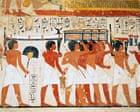
Court officials and craftspeople serving early Egyptian kings may have been sacrificed when their ruler died, according to research that found fractures in several ancient skulls.
The royal cemetery of Umm el-Qa’ab near Abydos features the tombs and enclosures of the First Dynasty rulers of Egypt, and dates as far back as 3,000BC.
Not only royalty were buried at the site: surrounding these structures are graves thought to belong to people associated with the royal households – including ladies, seal-bearers, inspectors and artisans.
Writing in the journal Frontiers in Environmental Archaeology, Dr Roselyn Campbell, author of the study from Purdue University in the US, notes: “While Aha, the first ruler of the First Dynasty, seems to have only had a few subsidiary burials, his successors included hundreds of subsidiary graves around their tombs and enclosures.”
The graves of the retainers were excavated in the 1920s by the English Egyptologist Flinders Petrie, who believed them to be an example of human sacrifice – a view some later experts agreed with.
Egyptologist Flinders Petrie examining pottery, 1932. Photograph: Fox Photos/Getty ImagesBut there was a snag: Petrie did not find any evidence of trauma on the remains. While he suggested the individuals may have been buried alive, others suggested the retainers died naturally and were later reburied at Abydos when their ruler died.
Campbell re-examined the skulls of 46 retainers excavated from graves surrounding the funerary enclosures of three different royals – King Djer, King Djet, and Queen Merneith – from the Duckworth Collections at the University of Cambridge.
“This question of whether or not retainer sacrifice was practised in Egypt has been debated for over a century, but this is the first study to examine the human remains from the tombs themselves,” Campbell told the Guardian.
Campbell reports that 18 of the skulls showed signs of potentially lethal trauma such as fractures and – in one case – a chopping injury to the eye.
Campbell believs Petrie may have seen the skull fractures but did not realise they were injuries that occurred around the time of death, rather than arising as a result of later damage.
The fractures, she adds, are unlikely to have been caused by a mace – a weapon often depicted in ancient Egyptian art as being used by a victorious king to smite his enemies. Instead they are more likely to have been caused by flat, wide objects made of wood or antler.
“For the crania without trauma, we cannot be certain they were sacrificed. It’s quite possible that some of the retainers were sacrificed, while others were not,” she said. “With such a small sample size of the original burial population, we simply can’t see the full extent of these funerary rituals, nor can we be sure that this sample is truly representative of all the retainers.”
Campbell noted the number of subsidiary graves tapered off quickly and seems to have disappeared with the beginning of the Second Dynasty.
Salima Ikram, a professor at the American University in Cairo, said while the idea of retainer sacrifice was not totally new, “this paper is one of the few times that rigorous current methodologies are being used to evaluate these remains”.
She added: “The practice was short-lived, with people being replaced by statuettes. Possibly some or all retainers felt that this was a boon and that they would enjoy an eternal life in the service of the god-king, though they might also have resented it, been terrified, and tried to escape this fate.”
Dr Dawn McCormack, an Egyptologist at Samford University, Alabama, said similar sacrifices had occurred across different cultures and times, adding that not everyone at the Egyptian site may have been compliant.
“If you really think about what those scenes would have looked like, it would have been very gruesome,” she said. While noting that the study only involved a small number of skulls from the burial site, “the idea that some of the people may have been violently killed, I think, is something that in reality we might expect”, she said.