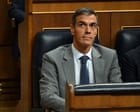
PM says vote will take place on 29 November after parliament rejected two of his government’s emergency relief measures
LIVE Updated 3m agoJakub KrupaMon 5 Oct 2026 03.10 EDTFirst published on Mon 5 Oct 2026 02.51 EDTShareKey events- 2m agoPedro Sánchez calls snap election for 29 November
- 10m agoSánchez speaks at La Moncloa
- 20m agoMorning opening: Spain's Sánchez to speak amid speculation over early election
Pedro Sánchez calls snap election for 29 November
There it is.
Sanchez calls snap election for 29 November.
ShareKey events- 2m agoPedro Sánchez calls snap election for 29 November
- 10m agoSánchez speaks at La Moncloa
- 20m agoMorning opening: Spain's Sánchez to speak amid speculation over early election
Sanchez says his government had to deal with “a highly contentious” parliament where “many confuse reaching agreements with betrayal,” and deal with “powerful economic and social elites” who want to influence Spain’s future without being ever elected.
He says his government had to deal with “the worst opposition in history,” as he says they never wanted to show any responsibility for the state, but kept challenging and questioning the legitimacy of the government.
He sums up what he says are his government’s achievements with Spain becoming the fastest-growing economy in the EU, recording a purchasing power increase “at three times” of France and Germany, but also with social and energy reforms.
“We have done everything in our power to defend the interests of the Spanish people,” he says.
He also points to his government’s decisions on foreign policy, with continued support for Ukraine, and work in the EU and at the UN, “fighting tyrants, oligarchs and speculators.”
He says it all transformed Spain into “a global example.”
It’s coming, surely.
Share7m ago03.04 EDTSánchez opens by saying that just over three years ago the electorate chose a progressive government following “the path of transformative ambition and social justice” that his government has been on since 2018 – despite various “unprecedented” emergencies and international challenges.
He very clearly sums up his government’s achievements and work of the last few years, so I think it’s pretty clear what’s coming next.
Share10m ago03.02 EDTSánchez speaks at La Moncloa
There he is. Let’s listen in.
Share10m ago03.01 EDTJakub KrupaThe very format of Sánchez’s appearance this morning – “an institutional declaration” – is in itself a very heavy hint at what we are likely to see this morning.
It essentially means it’s not a regular press conference, and the PM is unlikely to take questions – and he’s just there to tell us something important.
Spain’s housing crisis has forced people to take to the streets, urging the government to regulate housing prices and protect vulnerable people Photograph: Jesús Mérida/SOPA Images/ShutterstockHis appearance comes after up to 500,000 protesters gathered in Madrid on Saturday to demonstrate against soaring housing costs.
Public anger was triggered a week ago by the case of an elderly woman who had been forcibly evicted from her flat.
Sánchez’s minority government in response had tried to pass two relief measures: restrictions on evicting vulnerable tenants and an automatic renewal on tenancies.
But these were voted down by opposition parties in parliament on Friday. The rejection infuriated protesters.
Share20m ago02.51 EDTMorning opening: Spain's Sánchez to speak amid speculation over early election
Jakub KrupaSpain’s prime minister Pedro Sánchez is about to hold a press conference shortly amid speculation he is about to call a snap election to address a national housing crisis, after parliament rejected two of his government’s emergency relief measures on Friday.
Spanish right wing votes down housing crisis plans as protest movement growsRead moreThe vote prompted tens of thousands to march in the street on Saturday, in the capital Madrid and other cities. Protesters were calling for action on rent prices and tenant protections.
‘This can’t go on’: tens of thousands protest against housing crisis in SpainRead moreSpain’s next general election had been due next year, and Sánchez had previously said that he would complete a full four-year term.
But the defeats in parliament have raised questions on how effective his government can be in getting through key legislation, and analysts say while there’s the risk with an early election, it might be worth striking while the iron’s hot.
We will bring you the details as soon as Sánchez begins his speech.
Elsewhere, up to 500 schools remain closed in France following nationwide protests against classroom conditions last week which also saw outbursts of violence and teachers attacked.
And Germany – Ukraine’s largest financial backer – says it will not be intimidated by Russian strikes after chancellor Friedrich Merz announced $1.1bn in military aid in his surprise visit to Kyiv yesterday, which was also marked by a drone strike on a city bridge.
Ukrainian president Volodymyr Zelenskyy and German chancellor Friedrich Merz in Ukraine over the weekend. Photograph: dts News Agency Germany Bundesregierung/Tobias Koch/ShutterstockI will bring you all the latest from across Europe here.
It’s Monday, 5 October 2026, it’s Jakub Krupa here, and this is Europe Live.
Good morning.
ShareUpdated at 03.00 EDTExplore more on these topicsShareReuse this content