If you get Global News from Instagram or Facebook - that will be changing. Find out how you can still connect with us.
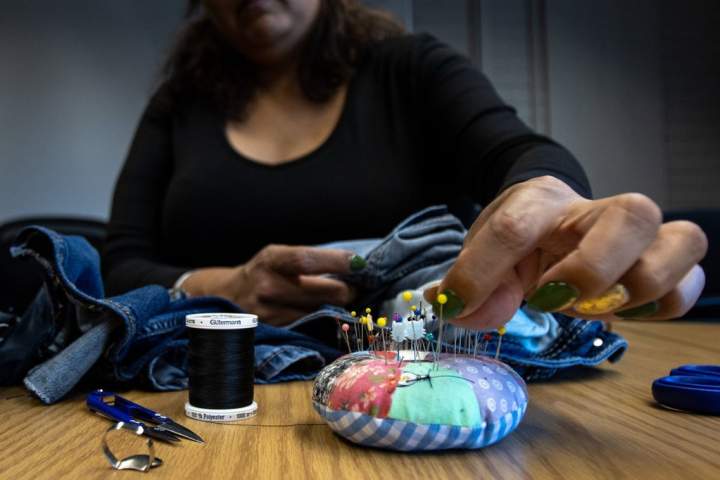
View image in full screen Bella, an attendee of the Clothing Repair Cafe, sticks a pin into a homemade pincushion at the University of Alberta in Edmonton on September 19, 2026. THE CANADIAN PRESS/Amanda May Erickson. AMEPearce Carpenter says fixing the holes in the black balloon bottoms they bought from an Edmonton thrift store is their way of tackling fast fashion.
“There is so much textile waste in the world, so if we just fix old clothes, like holes in the crotch areas of pants, it’s one little quiet act of rebellion,” said Carpenter, who uses they and them pronouns, while stitching over the part of the pants where two holes once were.
“Crotches wear out so quickly in pants just from rubbing your thighs.”
Before they started stitching, they said they lengthened the pants by cutting them near the ankles, adding a blue-coloured fabric with yellow squares and threading the ends back on.
“It’s such a fun way to add creativity to your wardrobe.”
Carpenter was among dozens who spent a part of their Saturday fixing old and beloved items at a clothing mending event at the University of Alberta called Human Ecology Clothing Repair Café.
Samantha Barrios Mendoza, a psychology student and event co-ordinator, said the gathering has been happening monthly for the last five years during the school year.
But the number of attendees has grown in the last year or so, likely due to the affordability crisis.
“I think people are starting to become more interested in learning how to mend because things are a little tight right now,” said Barrios Mendoza, as the sound of sewing machines and classical music hummed behind her.
Get daily National news
Get daily Canada news delivered to your inbox so you'll never miss the day's top stories. By providing your email address, you have read and agree to Global News' Terms and Conditions and Privacy Policy.“Why buy something new with hard-earned money when you can just repair something you love?”
Barrios Mendoza said many attendees believe repairing clothes can also reduce the environmental impact of fast fashion.
Fast fashion describes clothing produced quickly with cheap materials that copies popular styles from major fashion labels and designers. In recent years, fast fashion manufacturers have come under intensifying pressure to reduce their contributions to climate change.
The United Nations Environment Programme estimates that each year, the world generates fabric waste at a rate equivalent to a garbage truck’s worth being dumped or incinerated every second.
“There are new items and fabrics being pumped out every day in the fashion industry,” Barrios Mendoza said.
“So not buying new clothes and repairing is taking action for sustainability.”
Barrios Mendoza said that while repairing clothing does not reverse the climate crisis, it means a lot to the people who do it.
She said a woman once added floral trinkets to her wedding dress, and a mother used fabric she had kept since her kids were infants to make aprons for them after they grew up and moved away.
- House of Commons is back as Liberals vow ‘significant’ legislation coming
- Pickering nuclear reactors start coming off-line for massive refurbishment
- Vigil to mark 1 year since Nooran Rezayi shot and killed by police in Longueuil
- ‘Our hearts shattered’: Family of student pilot killed in crash mourns victims of latest Harv’s Air plane crash
“People have made memories through mending,” Barrios Mendoza said.
Attendees are provided with needles, threads, fabrics and ribbons, as well as drinks and snacks.
Experts also attend some events to teach new repair methods.
Most of the mending consists of fixing holes.
“We also do a little bit of resizing. People will bring in their skirts or their shirts, and they’ll bring them down a size or up a size, or they’ll turn some fabric into a bag,” Barrios Mendoza said.
She said she got into mending when she was a teen.
“I have a bag that I’ve had for 15 years, and hole after hole, straps falling down, I’ve just stitched it back together,” she said.
The stitches remind her of how much she has improved her mending skills over the years.
“Now it has patches and little stitch marks, and I can see where I started learning how to sew and then how the stitch marks got more even.
“The bag is now a piece of me.”
Tacjana Maj-Pfleger, another event attendee, said she takes pride in the things she has fixed.
“I have this ethos where good clothing doesn’t have to be new clothing,” she said, while sewing fabrics onto the back of an old denim jacket to make it thicker.
“I’m fairly poor, honestly, but also, fast fashion is terrible.”
Add Global News as a Preferred Source on Google to see more of our stories in your search results.
Journalistic standards Report an error © 2026 The Canadian Press
