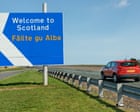
The emergence of “welfare nationalism” in the UK has created striking differences in benefit entitlement that result in a Scottish family on a low income receiving £15,000 a year more in state support than an identical household over the border in England.
A typical out of work couple with four children would have received £22,000 a year benefit income in York, compared with £32,000 in Belfast and £37,000 in Glasgow, according to new research on the impact of devolved welfare approaches
Other eye-catching divergences include benefit and grant entitlements that mean a baby in a family on universal credit in Scotland qualifies its parents for an additional £1,800 during its the first year of life, compared with England or Wales.
Devolved opt-outs from the benefit cap, which limits total benefit income to out of work households, mean Scottish and Northern Irish families are potentially thousands of pounds a year better off than their English and Welsh equivalents.
“More and more, the [social security] support people can receive when affected by things like low income, illness, disability or caring responsibilities depends on where in the UK they live,” said the study, published by the Safety Nets project.
The study, the first detailed analysis of devolution on social security policy, said variations in entitlements across the four countries only marginally increased overall UK welfare spending, while the structure of the system remained broadly the same.
But it said the financial impacts of these variations on individual households should not be underestimated, as devolved policies could make big differences to the living standards experienced by low-income households according to where they lived.
A panel of benefit recipients involved in the report praised some devolved welfare initiatives but added: “We are all part of the UK, and it can feel unfair when people in one area benefit from extra support that we can’t access ourselves.”
The £15,000 difference in benefit income for identical families in England and Scotland cited by the study is explained by more generous Scottish child payments and extra protections that shield the Scottish family from benefit cap limits that reduce the English family’s benefit entitlement by £8,000 a year.
Social housing tenants in Northern Ireland and Scotland also receive automatic protection from the “bedroom tax” imposed on households deemed to have more rooms than they need, saving them an average of £684 and £630 a year respectively. In England and Wales, help with bedroom tax costs is discretionary.
A question for those desperate to cut benefits to fund defence: who exactly are you willing to impoverish? | Polly ToynbeeRead moreBritain-wide variations in council tax support levels mean a family in England with an average council tax bill receiving the maximum council tax reduction (CTR) would have to pay £248 a year, compared with zero in Scotland and Wales.
There are stark variations in devolved council tax support levels in England alone. A family living in a band D property and eligible for full CTR in Doncaster would pay nothing. But if they moved across the border to North Lincolnshire, which has a maximum 50% CTR and caps support at Band B, they would pay £1,400 a year.
Devolved welfare policy, driven in part by the devolved governments’ desire to adopt more generous local payments and protections than those offered by the UK government, added about £1bn a year to UK social security spending in 2023-24, prompting questions of affordability from some quarters.
Most of the additional spending was in Scotland, which has most scope to shape its own social security policies. It was driven by the Scottish National party’s adoption of child payments of £28.20 a week per child to low-income families on universal credit, and top-ups to other benefits, from carer support to winter fuel payments.
More generous social security entitlements are key to the Scottish government’s ambition of reducing child poverty to 10% by 2030-31. While its child poverty rates are as a result the lowest of the four UK countries, current official projections indicate it will fail to hit its target without additional investment.
Although Wales has no devolved social security powers, the newly elected government, led by the Welsh nationalist party Plaid Cymru, has said it will trial a Scotland-style £10 a week child payment and lobby for devolved tax and social security responsibilities.
The State of the Nations study was compiled by a team of academics from three universities, together with the Resolution Foundation thinktank and the Child Poverty Action Group.