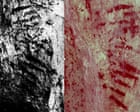
Scientific dating proves streaks on walls of Bacon Hole, near the Mumbles in south Wales, is Palaeolithic rock art
Dalya AlbergeMon 1 Jun 2026 02.00 EDTSharePrefer the Guardian on GoogleIn 1912, the Guardian reported on the discovery of Palaeolithic rock art on the walls of Bacon Hole, a cave near the Mumbles in south Wales – only for the painted panel’s authenticity to be dismissed by 1928.
A series of horizontal bands in red pigment were subsequently deemed no more than a natural phenomenon and the newspaper added an updated statement: “It was later established that the red streaks … turned out to be red oxide mineral seeping through the rock and not prehistoric art.”
But the original report has now been proved correct by new analysis.
Archaeologists have used the latest scientific means to date the rock art, discovering that it was in fact created 17,100 years ago – making it the oldest example in Britain as well as north-western Europe.
Dr George Nash, a British specialist in prehistoric art who headed an international team that conducted the new research, said: “This is the earliest prehistoric art we have in Britain.
“It was never considered to be rock art after 1928, and also it could never be dated, because in those days they didn’t have the scientific means that we have today.
“We’ve used uranium-thorium dating for the pigments. We’ve got data 17,100 years before present, which makes it the oldest rock art in the British Isles. I was taken aback that we were able to date it and analyse the pigments. This is an exciting rediscovery, significant in understanding what was going on in Wales in the deep past.”
William Sollas. Photograph: George NashHenri Breuil. Photograph: Courtesy of George NashThe initial discovery was made by professors William Sollas and Henri Breuil in 1912, when it was hailed as “the first specimen of prehistoric cave painting ever discovered in England”. The full extent of the imagery was not understood, partly because, in 1894, a local fisher had painted graffiti on the other side of the chamber.
Archaeometric analysis has now revealed a mix of calcite, consistent with the limestone geology of the region, and clay residues within a “pigment recipe”.
The academics concluded: “Based on both field observations … and laboratory examination of the pigment samples, it is evident that the pigmented lines were intentionally created by human agency, rather than resulting from natural processes.”
They added: “Based on the evidence … we concur with the original interpretation proposed by Breuil and Sollas in 1912 … The painted lines are arranged horizontally and are equidistant from one another, indicating a deliberate and structured pattern.” The paint was also applied by finger, the research showed.
Bacon Hole is located within the limestone cliffs of south Gower, overlooking the Bristol Channel. Although in an area of outstanding natural beauty, it is not protected as a “scheduled monument”, but the archaeologists argue that it should now become one.
The cave is under the custodianship of the National Trust of Wales, which will officially announce the research this week.
Welsh-born Nash is associate professor at the Geosciences Centre of Coimbra University in Portugal and honorary research fellow within the Department of Archaeology at the University of Liverpool.
He and international academics have just published a scientific paper on their research in the journal Quaternary.
They write that, about 17,100 years ago, Wales was emerging from a severe cold phase of the Devensian glaciation: “During this period, the climate was gradually shifting from a near-uninhabitable frozen landscape to a treeless periglacial environment with sparse vegetation.
“The area now occupied by the Bristol Channel, where Bacon Hole lies along the northern shoreline, would probably have served as a favourable catchment for migratory megafauna grazing during the summer months. At the same time, Bacon Hole and other caves along what is now the southern coastline of the Gower peninsula would have offered suitable habitation sites for hunter-fisher-gatherer groups.”
The research was conducted by First Art, a group of scientists, as well as academics from the universities of Southampton and Swansea, among others. The project was made possible through support from the National Trust and the Bradshaw Foundation.
Rare examples of rock art of the Upper Palaeolithic in Britain include one that Nash discovered in 2010 at Cathole Cave, Parkmill, about two and a half miles from Bacon Hole, which has a minimum date range of between 14,500 and 12,500 years ago.
Explore more on these topicsShareReuse this contentGiant green pickle tells us UK’s Jewish culture month has begun
16 May 2026Victorian time capsule: exhibition tells story of Brodsworth Hall in Yorkshire
27 Mar 2026Ministers consider charging tourists to enter national museums in England
26 Mar 2026Rare bronze and iron age log boats reveal details of Cambridgeshire prehistory
14 Nov 2025‘Our last heritage asset’: fears for Walsall Leather Museum as council plans to sell
27 Oct 2025Faceless figures and mysterious music: ghost stories from English Heritage sites
24 Oct 2025Champagne, celebs and artefacts: British Museum hosts first lavish ‘pink ball’ fundraiser
18 Oct 2025Underground zip wire plan for Lake District approved by judge
15 Oct 2025Bronze age gold jewellery stolen in raid on St Fagans museum in Cardiff
6 Oct 2025‘A hub of humanity’: National Railway Museum space reopens after £11m refit
26 Sept 2025