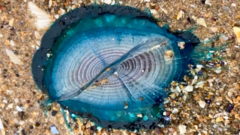
Hundreds of "stunningly beautiful" blue sea creatures have washed up along parts of the Welsh coastline.
Velella velella, commonly known as by-the-wind sailors and closely related to the Portuguese man o' war, have been spotted on beaches across Anglesey, Gwynedd and Tenby.
One woman who found one of the free-floating hydrozoans on Tenby South beach said it was "like a crystal".
Marine specialist Frankie Hobro, of Anglesey Sea Zoo, said the creatures were beautiful but warned people not to touch them due to their sting.
Nature lover Maxine Allinson was walking on Tenby South beach on Tuesday when she spotted a by-the-wind sailor for the first time.
"It was fantastic," said the 49-year-old. "They are so beautiful."
Frankie HobroFrankie Hobro discovered one of the creatures on the beach at Trefor on the Llŷn Peninsula on SundayThe nickname - by-the-wind sailors - comes from their small sail-like structure, which catches the wind and moves them across the ocean surface.
Hobro said they were often mistaken for Portuguese man o' war but were much smaller, "brighter blue" and "generally harmless".
"So you get the kind of blue tides of the by-the-wind sailors and obviously if they catch the sunlight as well it really sparkles," she said.
"It's stunningly beautiful and the Portuguese man o'war even more so because they have these kind of purples and pinks as well."
Hobro said by-the-wind sailors were relatively common, usually appearing in autumn and winter when ocean currents carry them long distances.
About 7cm long, they cannot move themselves and are often "dumped" ashore after storms or changes in currents.
Large groups strand together, she explained, because they travel in the same currents and are deposited along coastlines at the same time.
Similar to Portuguese man o' war, by-the-wind sailors are colonies of animals related to sea anemones and corals, and they possess stinging cells.
Although their sting is generally considered "very mild" in comparison to Portuguese man o' war, Hobro advised people not to touch them.
"You probably wouldn't feel it through normal fingers because human skin is fairly thick," she said.
"But if you touched your lips, face or another sensitive area, it could be quite painful and cause a tingling sensation."
She warned that even when washed ashore and appearing dead, their stinging cells can remain active and still cause discomfort and urged people to admire them from a distance.
More top storiesAbuse hurled at judge as first group of rioters sentenced for Ely disorder
Our son's final days were transformed by a hospice, but we only discovered it by chance
Three arrested after record-breaking £139m cannabis seizure
WalesTenbyMarine lifeRelatedSchool offers pupils 'full roast dinners' in the morning to tackle hunger
I've had two heart transplants - now my son may need one and I'm terrified
How a young politician's journey took her from poverty to Team GB gymnast
More from the BBC5 days agoWhy it's so hard to help a stranded whale
5 days ago6 days agoOutdoor photography exhibition celebrates wildlife
Secrets Beneath the Sea is a free outdoor attraction at Brighton Seafront Gallery until 19 July.
6 days ago5 Jun 2026School needs new roof just 10 years after opening
It is unclear where pupils will go while it is repaired, with several options being considered.
5 Jun 20263 Jun 2026New signs for deaf visitors at city aquarium
The displays have newly created sign language words for more than 80 marine animals.
3 Jun 202619 May 2026MP submits petition to ban plastic bio-beads
Helena Dollimore MP presents a 10,000-signature petition calling for an end to plastic bio-beads.
19 May 2026