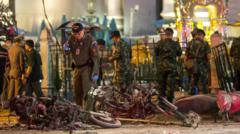
A court in Thailand has found two men guilty of carrying out the country's worst ever terrorist attack and sentenced them to death.
The two men, both from China's Uyghur minority, were convicted of planning and detonating a powerful bomb on the evening of 17 August 2015, next to a shrine in central Bangkok that is popular with foreign tourists.
Twenty people were killed and more than 120 were injured.
However, flaws in the police investigation, and in the ten year-long trial of the two men, who both pleaded not guilty, have left questions hanging over this verdict.
The bomb exploded a short distance from the BBC bureau in Bangkok, and I was there within a couple of minutes.
The blast had ripped through people praying at the Erawan shrine, and knocked over motorbike riders waiting at the nearby intersection, setting some of them on fire.
Paramedics and ambulances were quickly on the scene and began treating the injured, or laying sheets over the dead.
I watched them helping a man, whose wife lay lifeless next to him. His injuries were not life-threatening, so they gently asked him to wait, getting him to hold his wife's hand, while they tended to other casualties.
It was loud, chaotic, and profoundly shocking. I had seen plenty of political violence in Bangkok, but a bomb attack of this size was unprecedented. Who could have carried it out, and why?
ReutersThe blast had ripped through people praying at the Erawan shrineFrom the start the official investigation was less than reassuring. Worried about the impact on the all-important tourist industry, the government ordered the scene of the attack to be cleaned up as quickly as possible. The shrine was reopened two days later, the crater left by the bomb cemented over.
Many of the security cameras in the area were found to be not working, but some grainy video did show a man with long hair and thick glasses leaving a backpack under a bench and walking quickly away.
His trail was lost, but the police showed video of another man in a different location kicking what turned out to be a second bomb into a canal, where it exploded harmlessly. They said they were looking for several suspects, but insisted the bomb was not an act of terrorism.
Within two weeks of the attack they had arrested the two men who have now been convicted.
Bilal Mohammad was found hiding in a house on the outskirts of Bangkok where the authorities also discovered chemicals suitable for making bombs. He had a forged Turkish passport, under the name Adem Karadag. Yusufu Mierali was apprehended in Cambodia, and handed over to Thailand.
Both men were identified as Uyghurs, but initially the Thai police said neither was the person who planted the bomb. Later they charged Bilal Mohammad with the crime, although he bore little resemblance to the man in the video. Arrest warrants were also issued for 13 other people, some of whom had already left the country.
Why do people visit Bangkok's Erawan shrine?
The victims of the Bangkok blast
Unsurprisingly people began to link the bomb to the controversial Thai decision the month before to forcibly repatriate 109 Uyghur men to China, which provoked angry protests by Uyghur sympathisers in countries like Turkey. The shrine was well known as especially popular with Chinese visitors. It looked like an act of retribution.
But the military government refused to accept this possibility. At one point they suggested it might be disgruntled opponents of the military junta which had seized power the year before. Later they insisted that it was just human traffickers angry at the government's efforts to shut down their activities.
In a bizarre twist the police offered a reward of $80,000 to anyone who led them to the culprits – then awarded it to themselves once they had their first two suspects in custody, despite acknowledging that many more suspects were still at large. Case closed, they said.
Both suspects were kept in military custody, and complained that they had been tortured into making confessions. They withdrew these once the trial, in a military court, began.
Bilal Mohammad appeared to be extremely distressed, shouting that he was being mistreated . He testified that he had been waiting at the house where he was apprehended for a smuggler to move him to Malaysia, from where he wanted to fly to Turkey, a well-established route used by Uyghur asylum-seekers.
Then the delays began. Usually it was because the Thai authorities said they could not find a Uyghur-speaking translator. The defendants rejected those offered by the Chinese embassy. The delays went on and on, for more than ten years.
The International Commission of Jurists is one of several human rights groups which have criticised the procedures and extraordinary duration of the trial, arguing that it was so problematic the two suspects should have been released.
"The investigation, prosecution, and trial of Bilal Mohammed and Yusufu Mieraili have been rife with human rights violations and have exposed some of the systemic deficiencies of Thailand's criminal justice system."
However the judges ruled that there was sufficient evidence to justify convicting them, in particular records of phone calls submitted by the police that show both men near the scene of the crime at the time of the bombing, and communicating with each other.
The lawyer for the two men has said they will appeal against the verdict.
ThailandAsiaRelatedThe college scam that promised students fleeing war a new life in Finland
In pictures: Thai Princess Bajrakitiyabha dies at age 47
Thailand’s royal household announces death of Princess Bajrakitiyabha
More from the BBC1 day agoJapanese pop group XG went from brutal five year training to global pop stars
The Japanese pop group have become global stars, after being recruited before they were teenagers.
1 day ago2 days agoDo it at home too, women tell Japanese fans who cleaned World Cup stadium
Some see a double standard: Japanese men who clean in public while their wives do all the housework.
2 days ago3 days agoJapan ramping up defence is 'critical' to prevent war, Defence Minister Koizumi tells BBC
3 days ago4 days agoWatch: Japan's unusual course on avoiding a bear attack
4 days ago4 days agoTelegram challenges India ban over exam paper leak fears
Telegram CEO Pavel Durov has called the ban a "mistake", arguing it would punish millions of users.
4 days ago