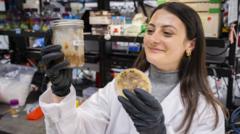
Vayu Hill-Maini's lab has created a new cheese, or at least something that tastes like cheese, but is actually made from food waste.
The bioengineer, who runs a lab at Stanford University in California, is experimenting with fermentation using fungi.
"One of the most amazing things that we found recently is that we could take waste and add a few other ingredients in a fungal fermentation and create this delicious cheese that is like a Pecorino or Parmigiano," he says.
Fermentation is a biological process whereby organisms convert carbohydrates like starch or sugar into substances like alcohol, without using oxygen.
Perhaps the best-known examples of fermentation are in baking and brewing, where yeast breaks down sugar into ethanol and carbon dioxide.
But it's not just wheat flour, or barley that can fuel fermentation, all sorts of substances are suitable - in biology those fermentation hosts are known as substrates.
With the latest biotech tools, companies are taking by-products of the food industry, that are currently discarded or have little value, and using fermentation to turn them into something useful.
Franklin LurieStanford University scientists are using fermentation to transform food wasteUK-based Fermtech is transforming cocoa shells, which are normally thrown away, into a cocoa powder substitute, using fermentation.
"If you were to sniff a bag of cocoa shells, you would be really struck by the intense chocolatey nature of it," says Andy Clayton, Fermtech's CEO.
He says it's a shame that by-products of the food industry are composted or burnt, rather than using microorganisms to break down the hard bits of the plant and make it bioavailable for humans, while retaining the flavours.
Utilising a broader palette of substrates can save money, help the environment, and expand flavour.
"We're kind of like flavour miners," says Clayton says.
Take peas. Protein makes up about a quarter of a pea, and pea protein has become an increasingly popular source of plant-based protein.
What then to do with the other three-quarters of the pea?
That makes "a perfect substrate for fermentation," according to Bosco Emparanza, the CEO of Spain's MOA Foodtech.
His company gathers data on environmental conditions and available substrates, and sequences the genomes of microorganisms appropriate for the food industry.
With that data, MOA has trained an AI to work out what combinations of substrates and microorganisms would achieve the best yields.
Emparanza marvels at the speed of such AI-driven fermentation design.
"When we started the company, we were able to develop one bioprocess in two weeks," he says, referring to the use of living cells to generate a product.
"Nowadays, the platform can develop 300 bioprocesses per hour."
Using that tech, MOA Foodtech discovered the best microorganisms to make use of the leftover starch and fibre in the pea protein industry.
Those byproducts would normally get sold at rock-bottom prices for animal feed, for instance, or possibly even discarded.
MOA Foodtech is working to put those byproducts back into the human food chain.
Getty ImagesThree quarters of the pea is not used in making pea proteinGermany's MicroHarvest has developed a confidential process which speeds up the fermentation process.
MicroHarvest uses byproducts of the sugar industry, such as molasses, which isn't typically eaten in Germany.
Rather than the sugar industry turning this over to farmers to feed cows, MicroHarvest is working with sugar makers and pet food producers to convert side streams into premium pet food.
Katelijne Bekers, the CEO and co-founder of MicroHarvest, describes the cat snack Vegcat as having an umami taste without the bitterness of some plant-based proteins.
Christine RoJonathan Roberz and Katelijne Bekers turn molasses into pet foodSingapore's Mottainai Food Tech also has a mission to use unconventional and underappreciated ingredients, which can be nutritious and widely available throughout Asia.
The inspiration for the name comes from the Japanese term mottainai, which laments waste - think of the phrase "waste not, want not" and you have the sentiment.
The company has produced a meat substitute called Jiro Meat based on okara, a soy pulp typically discarded after making tofu and soymilk.
Mottainai also recently started a plant-based tuna project.
They've experimented with different microorganisms to minimise off-flavours and maximise desirable flavour compounds such as umami or sweetness.
Singapore has a supportive environment for these kinds of food experiments.
"In five years' time, we hope to be able to have a wide range of ingredients" drawing on the company's fermentation platform, says Daryl Pek, a cofounder of Mottainai Food Tech.
MottainaMottainai's meat substitute is part of this pizza's toppingBack in Stanford, Hill-Maini's lab is working on precision fermentation.
This involves genetically engineering microorganisms, such as moulds, to produce a specific material in a fermentation process.
Precision fermentation can efficiently adjust the aesthetics, aroma or flavour of a food, but also its digestibility.
For instance, Hill-Maini says that some waste products are rich in cellulose, which humans can't digest. But as they grow, fungi can break down the cellulose and convert it into protein.
"They become kind of a bioconversion machine where they can remove some of those complicated molecules that the human gut cannot digest and convert them into more digestible substances."
Hill-Maini believes that his lab's work inspires others to think differently about food waste. But he doesn't want this work to stay in the lab.
They have a chef in residence and an R&D culinary innovation kitchen to ensure that their food experiments are as appealing to potential consumers as possible.
Of the recently developed Pecorino-like cheese, the lab used a Neurospora mould, but would not say what waste was used as a substrate. That's secret until they publish a paper about their work.
But he's excited about the new "cheese".
"You can grate it, it's salty, it has a nice texture, it can be added to pasta. And it's just really cool to see… the fermentation can help it become delicious."
More Technology of BusinessInside the secretive and lucrative world of orchid breeding
Not so dusty: How tech is changing woodworking
Why Spotify has no button to filter out AI music
Food industryFood wasteTechnology of BusinessInternational businessTechnologyRelatedTemperatures are rising - and so are ice cream prices
Former Brewdog bar to reopen as live music venue
CO2 plant reopens to combat possible food shortages
More from the BBC24 hrs agoThe game-changing tech transforming the World Cup
24 hrs ago1 day agoChina cracks down on soft porn, violence and materialism in viral micro dramas
Micro dramas have surged in popularity, but drawn criticism for often sensationalist content.
1 day ago1 day ago'World-first' vaccine designed by artificial intelligence
Cambridge scientists say they have, for the first time, tested a vaccine designed by AI.
1 day ago1 day ago