Warning, some of the details of this story are disturbing
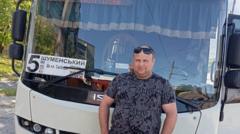
Anatoly Dmytrov was driving his bus on Route 14 in the southern Ukrainian city of Kherson earlier this month.
The bus was full and people were standing in the aisle, when it reached an intersection and it was hit by a Russian drone.
"All the windows got smashed. I barely made it to the next stop, where there was a shelter. I looked in the mirror and saw blood. I thought - oh, I need to get to the shelter quickly because sometimes they send a second drone immediately," Anatoly said.
He was in shock after the attack, and at least eight of his passengers were injured, he added.
"It's no fun working here," Anatoly said. "This happens almost every day, they've started hunting buses down. You go to work and you have no idea if you are going to come home."
Kherson's municipal transport company, where Anatoly works, says the attacks started last year and are getting worse. Public transport has become a priority target for Russian drone operators, the company said in a statement shared with the BBC.
This year alone, three of its workers have been killed, eight wounded, and 21 of its trolleybuses and eight buses damaged. Local authorities say six privately operated buses have been hit in 2026, too.
Kherson local authorityTwenty-seven Kherson buses have been bombed so far this year, killing three transport workersAbout 65,000 people are still thought to be in Kherson, a city of some 300,000 residents before the war.
The city is firmly under Ukrainian control and yet it is the administrative centre of one of the five Ukrainian regions which Russia claims as its own.
It was occupied by the Russians in the first few days of the full-scale invasion of 2022, then retaken by the Ukrainians in autumn of the same year, and since then has been relentlessly attacked by Russian forces from across the Dnipro river.
Rita Dobrinova, a manager at the Kherson municipal transport company, believes the threat from Russian drones is getting worse, particularly since they started using optic fibre cables, which are immune to jamming.
"Some are just hovering, waiting. Others are scout drones. They look the driver right in the eye through the windscreen," she said.
"There is a bus driver who had a bomb dropped literally on to his head on 11 April. It went through the cabin's roof and fell on his head," she recalled of one fatal attack.
Authorities in Kherson have taken steps to protect bus drivers and their passengers. Some of the busiest streets are covered with anti-drone nets protecting pedestrians and traffic underneath, and authorities say drivers are given helmets and bullet-proof vests.
They were also issued with drone detectors, called chuyka, but they are of limited use.
They only detect approaching drones which use known frequencies for navigation, but machines relying on fibre optic cables or new frequencies are invisible to them.
Although Kherson itself is under Ukrainian control, the wider region on the other side of the Dnipro river is held by the RussiansThe municipal transport company currently has about 30 buses. "I can't say each one of them will meet a drone every day," said Ms Dobrinova. "But the drone detector will beep once in an hour or an hour and a half. All it tells you is that there's a drone around. It will show your distance to it in metres or kilometres."
If the chuyka goes off, bus drivers are supposed to stop, let their passengers out and direct them to the nearest shelter.
Even getting to work can be lethal. Another bus driver, Eduard Zadorozhny, was being taken to work together with colleagues in a company van on 3 May when it was targeted.
"They hit us, we got out, and when an ambulance arrived to help us, they hit the ambulance."
Deliberately targeting medical workers is a war crime under international law.
Kherson local administrationA Kherson bus driver recent had a bomb dropped directly on his head while at work"What they do is hit you, and then they hit you again. They've turned people's lives into a horror show," Eduard told the BBC.
Eduard was concussed but one of his colleagues, an engineer, was killed.
But why do bus drivers in Kherson keep going back to work, despite the severe danger?
"We need to get people to their pharmacies and hospitals: children and the elderly, everyone who has stayed here, everyone who still lives here," said municipal driver Maksym Dyak. "No-one apart from us will do this. We realise that if we abandon these people, no one else will drive them."
Getty ImagesRussia is accused of targeting civilians in Kherson, with some referring to it as a "human safari"Like his colleagues Anatoly and Eduard, Maksym has also been targeted by Russian drones. He was hospitalised with a broken rib and shrapnel embedded in his chest earlier this year.
"We work like rats in a cage. We get attacked from every side, but we keep driving," Maksym added.
Towards the end of my conversation with Maksym, I asked him whether he ever considered leaving Kherson.
"I never thought of leaving. This is where I was born, this is where I live and this is where I'll live until the very end. I'm not going anywhere."
More on this storyRussia ramps up threats against Ukraine. What does that say about the war?
Inside the 'kill-zone' on Ukraine's front line, where new weapons have transformed war
RussiaUkraineEuropeWar in UkraineDronesRelatedHow Putin became master of the image
'I will sleep with fear': Romanians shaken after block of flats hit by drone
Ukraine using AI drones to strike vital convoys supplying Russian troops
More from the BBC8 hrs agoDead whale towed ashore in Denmark ahead of autopsy
"Timmy" was found dead off the coast of Anholt despite multiple attempts to rescue it.
8 hrs ago1 day ago'No-one feels safe now': Residents of Romanian city hit by drone share fears
1 day ago2 days agoSpain's Sánchez digs in after eight years as PM as wave of scandals threatens survival
Corruption probes of colleagues and relatives have put Spain's premier into a fight for survival.
2 days ago2 days ago