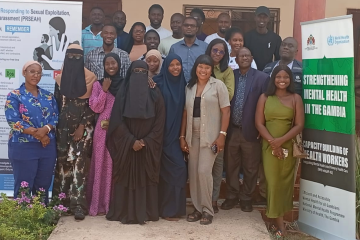
Tendaba, The Gambia – May 2026 – For many people in The Gambia, seeking help for mental health conditions is not always easy. In rural areas especially, access to specialized services often means travelling long distances, facing financial constraints, and overcoming stigma that discourages open discussion of mental health.
To address these barriers, the World Health Organization (WHO), in collaboration with the Ministry of Health and the National Mental Health Programme, conducted a four-day training on the WHO Mental Health Gap Action Programme (mhGAP) 2.0 guidelines from 11 to 15 May in Tendaba Camp.
The training brought together 25 healthcare workers from across the country, including nurses, midwives, and community health workers from across the country. As the first point of contact for many patients, these providers play a crucial role in expanding access to mental health care at the community level.
“This training has changed how I understand and approach mental health conditions,” said one participating nurse. “I now feel more confident identifying patients who need support and providing care with empathy.”
Mental health services in The Gambia have historically been concentrated in urban centers, leaving many communities undeserved. As a result, conditions such as depression, anxiety, epilepsy and substance use disorders are often undiagnosed and untreated, with significant consequences for individuals, families and livelihoods.
The mhGAP 2.0 guidelines are designed to bridge this gap by enabling non-specialist providers to deliver evidence-based mental health interventions within primary health care (PHC). Through interactive sessions, including case studies, role plays and group discussion, participants learned how to recognize, manage and refer common mental health conditions.
This training builds on national commitments already expressed by the Minister of Health, Hon. Dr. Ahmadou Lamin Samateh, during the launch of the Mental Health Investment Case Report 2025 and the National Mental Health Policy (2025–2030). At that time, he emphasized the importance of integrating mental health into primary health care as a foundation for achieving universal health coverage.
He stated, “Integrating mental health into primary health care is essential to achieving universal health coverage,” adding that strengthening front line capacity improves access and reduces delays in care.
The impact of such training extends beyond clinical knowledge. By building the confidence of front line providers, the initiative is also helping to address stigma associated with mental health. In many communities, misconceptions and fear prevent people from seeking care. Trained providers are better equipped not only to treat patients but also to foster supportive and respectful environments.
For communities, this shift could be transformative. A young person experiencing anxiety may now receive timely care at a nearby health facility. A mother facing emotional distress after childbirth can be identified early and supported before her condition worsens. Families caring for relatives with mental health conditions can receive guidance locally rather than travelling long distances.
“People trust us because we are part of the community,” said a community health worker who attended the training. “Now we have the skills to support them in ways we could not before.”
The initiative also contributes to strengthening the national health system. Integrating mental health into PHC improves the availability, affordability and continuity of services, while easing the burden on specialized facilities. It aligns with The Gambia’s commitment to universal health coverage, where mental health is recognized as a core component of overall health and well-being.
At the end of the training, participants committed to sharing their knowledge with colleagues through mentorship and peer learning, helping to extend the impact across the health system.
WHO continues to support The Gambia in scaling up mhGAP implementation as part of broader efforts to strengthen community-based care. While the training lasted only a few days, its effects are expected to be long-lasting- helping to transform how mental health services are understood, delivered and accessed across the country.
Click image to enlarge For Additional Information or to Request Interviews, Please contact: Halle Abdullahi MohamedExternal Relations & Communications Officer
WHO Gambia
New Kotu Layout,
Kotu, The Gambia
Phone: +220 4462283
Mobile: +220 7200265
Email: halmohamed [at] who.int (halmohamed[at]who[dot]int)

