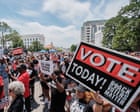
Thousands of people from across the country descended on Montgomery, the capital of Alabama, on Saturday. They arrived by bus, by car and by plane to gather for the All Roads Lead to the South rally, following the supreme court’s Louisiana v Callais decision last month, which essentially gutted the Voting Rights Act and severely limited protections against voting discrimination.
Organized by a coalition of national and local civic engagement groups, the rally took place outside the Alabama state capitol building, in the same plaza where the 1965 Selma to Montgomery voting rights marches – three nonviolent demonstrations in support of Black voting rights – are enshrined.
“We’re here, Montgomery, not at a stopping point, but at a starting point,” Steven L Reed, mayor of Montgomery and the first Black person to hold the position, told the crowd. “We’re here in this city because of the spirit, because of the courage and because of the commitment of our forefathers and foremothers who got us to this point.”
Montgomery mayor Steven Reed in Montgomery on Saturday. Photograph: Alyssa Pointer/ReutersAlexandria Ocasio-Cortez in front of the state capital in Montgomery, Alabama, on 16 May. Photograph: Dan Anderson/Zuma Press Wire/ShutterstockFollowing the supreme court decision, Republican-led states rushed to redraw their voting maps in ways that weaken Black political power. Tennessee and Florida have already passed new maps, while Alabama, Louisiana and Georgia seem poised to follow. Mississippi temporarily paused redistricting efforts, with the state’s governor promising to revisit the issue soon.
Voting activists from these states affected by Republican redistricting attempts – along with local and national elected officials, including the senators Cory Booker and Raphael Warnock and the representatives Terri Sewell, Shomari Figures and Alexandria Ocasio-Cortez – took the stage to mobilize and energise attendees.
“We need to fight with all we got,” said Charlane Oliver, a Tennessee state senator who protested the state’s redistricting by standing on her desk last week. “They may draw some racist maps, but we are the south, this is our south. The south belongs to us. The south got something to say, and we gon’ speak real loud and clear in November.”
Throughout the event, spontaneous chants of “vote, vote, vote” emerged from the audience. At times, All Roads to the South felt like a worship event, harkening back to the Black church’s vital role in the civil rights movement. It began with a prayer; when an attendee had a medical event, an emcee asked those gathered to “put their praying hands together”. Multiple gospel songs were performed throughout the day.
Throughout the event, spontaneous chants of ‘vote, vote, vote’ emerged from the audience. Photograph: Mike Stewart/APFor many attendees, being at the rally was personal. Their family members fought for voting rights. Now, they said, it’s up to them to take up the banner.
“My grandmama, my momma, my mother-in-law – our ancestors did not cross that bridge, walk during the bus boycott, my cousins got locked in the First Baptist Church [in Montgomery], across from the police station in the 60s, my other cousin got beat up by a horse up on Jackson Street – we didn’t do all that for this,” said Carole Burton, a Montgomery resident.
The day began in Selma, with a prayer service at the historic Tabernacle Baptist church, followed by a silent walk across the Edmund Pettus Bridge, the site of the brutal “Bloody Sunday” violence against civil rights marchers in 1965. From there, those who attended the actions in Selma traveled by bus to Montgomery, where they were joined by thousands.
All Roads Lead to the South was not an isolated event – more than 50 satellite events were scheduled across the country for people who couldn’t make it to Alabama. Speakers also noted that the fight would continue elsewhere.
“Our task is bigger than defending the past,” Rukia Lumumba, director of the Mississippi VRA Rapid Response Coalition and M4BL Action Fund, said. “Our task is to build a democracy worthy of the people who bled to create it in the first place.”