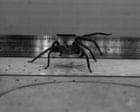
A brown huntsman is the quickest of more than 250 species analysed by scientists in the UK and Germany
Graham Readfearn, Nick Evershed and Andy BallThu 9 Jul 2026 11.00 EDTSharePrefer the Guardian on GoogleIf arachnophobes were not frightened enough by the horrific ability of Australia’s huntsman spiders to drag dead mice up the sides of fridges, they now have another reason.
They might be the fastest spiders on the planet.
One member of the huntsman family, the brown huntsman Heteropoda jugulans, was clocked as the quickest of more than 250 spider species analysed by a team of scientists in the UK and Germany.
Reaching a peak speed of 3.59 metres per second (13km/h or 8mph), the humble and hairy-legged huntsman appears to be faster than the current world record-holder, the Moroccan flic-flac spider and its comparatively pedestrian 1.7 m/s (they don’t so much run, as tumble down hill to reach that speed).
The scientists collected 162 different spider species – mostly from around London and the German city of Greifswald, but also from North America, southern Europe and Australia – and then measured their running speeds using cameras and gridded paper as the running track. The research has been submitted to a scientific journal.
They also added to their analysis other studies that had measured spider speed and, crucially, that included research supervised by Dr Christofer Clemente, an evolutionary biomechanist at the University of the Sunshine Coast in Queensland.
Clemente’s research was originally published in 2021 and aimed to understand the unique way that spiders get about.
But rather than go searching for what he thought would be the quickest spiders, Clemente said he just grabbed the ones that were the easiest to get.
“These were just spiders I found in the back yard,” Clemente said. “I could just go out with my head torch and see them on the grass.
“I am interested in how different animals of different sizes move and whether muscle might limit the speed at which animals can run,” he said.
“Spiders don’t move using just muscle – they use a combination of muscles to retract their limbs and hydraulic pressure to push them outwards.
“That’s a completely different way of powering locomotion to other animals.”
The brown huntsman only lives along Australia’s east coast and is a common site in homes in south-east Queensland.
They are about the size of a hand and while they are venomous they very rarely bite humans and when they do, the effects are mild.
While the 3.59 m/s was the peak speed recorded by the huntsman, Clemente said this was only reached for a fraction of a second. The huntsman’s average sustained speed was closer to 2 m/s.
“That’s still really fast,” he said.
When it comes to running in the animal kingdom, he said generally there appeared to be a “sweet spot” between having legs and muscles that were long but “not so big that you have to support this huge mass”.
His hunch was that huntsmans “might be close to the sweet spot” for the best spider body type for speed.
“They’re not too big and not too small, but we haven’t done the science on that yet,” he said.
Do bees have inner lives? Slow-motion video reveals bumblebee behaviour similar to ‘liking’ or ‘disliking’Read moreDr Jonas Wolff, of the University of Greifswald in Germany and one of the lead authors of the new research, said it was the broadest comparative study of running speed in spiders ever conducted.
Running speed can determine how spiders interact with the environment, how far they disperse and “which ecological niche they occupy”.
One key finding was that “it was not the largest species that ran the fastest” and that spiders that caught their prey in webs were not necessarily slower than hunters like the huntsman.
“Instead, the data indicates there is a threshold in body mass, after which running speed drops due to mechanical constraints in muscle physiology and the spider’s body plan.”
So is the brown huntsman the fastest spider in the world?
“I would not rule out there are faster huntsman species than this one out there, which have not been tested yet,” he said.
Explore more on these topicsShareReuse this contentNeil the one-tonne elephant seal causing traffic jams in rural Tasmania has returned to sea – for now
7h agoDo bees have inner lives? Slow-motion video reveals bumblebee behaviour similar to ‘liking’ or ‘disliking’
3d agoNSW’s deadly one-in-100-years floods could have been slashed by two metres using dams, CSIRO finds
30 Jun 2026A deadly strain of bird flu has landed on Australian shores. Does it pose a risk to pets?
4d agoScientists in Australia find ‘smoking gun’ evidence of world’s oldest meteorite strike
23 Jun 2026NSW records first suspected case of deadly H5 bird flu as virus reaches Australia’s east coast
7d agoFull StoryEl Niño is imminent. How worried should Australians be? – Full Story podcast
9 Jun 2026Tasmanians warned of ‘loving Neil to death’ as 1,000kg seal’s antics feed ‘double-edged sword’ of fame
2 Jul 2026Blue mushrooms, shy trees and glowing seas: Beaker Street science photography prize – in pictures
9 Jun 2026A 1,000kg mammal is wreaking havoc in Tasmania – and Neil the seal is loved for it
1 Jul 2026