Youth-led movement calls on education minister to quit in one of India’s largest anti-government rallies in years
Hannah Ellis-Petersen in DelhiMon 20 Jul 2026 07.37 EDTFirst published on Sun 19 Jul 2026 20.42 EDTSharePrefer the Guardian on GoogleTens of thousands of protesters have defied police orders and descended on Delhi to demand the resignation of India’s education minister in one of the largest anti-government demonstrations in years.
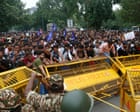
A huge crowd, largely made up of students and gen Z-ers, filled the streets in the heart of India’s capital from early Monday morning shouting anti-government slogans. Hundreds had already camped out overnight.
Delhi police, which are under the control of the central government, had denied permission for the march to take place. A ban was imposed on all public gatherings, roads across the city were barricaded and the internet was shut down in the centre. Attempts by protesters to move towards the parliament building were met with police brutality including the use of batons and teargas.
However, this did little to prevent protesters turning out in their thousands, many of whom were vocal in their anger at Narendra Modi’s government and his ruling Bharatiya Janata party (BJP), accusing them of failing the country’s young people.
“They are calling this protest illegal, they are calling us anti-national,” said Rhythm Katoch. “But I am 22 years old and I am standing here to fight for our education system, for the rights of the young people and for our democracy. Is it too much to ask for the government to listen to us?”
The protesters were vocal in their anger at Narendra Modi’s government and his ruling Bharatiya Janata party. Photograph: Shekhar Yadav/APA call had been made to march on parliament by the Cockroach Janta party (CJP), a new youth-led movement whose name was inspired by remarks made in May by Surya Kant, the chief justice of India, when he called some activists and unemployed youth “cockroaches”. While the CJP began as satire, founded by the graduate Abhijeet Dipke in May, it has swiftly mobilised into a serious political challenge to the Modi government.
Its core demand has been the resignation of the education minister, Dharmendra Pradhan, over exam chaos, after this year’s medical entrance exam – where more than 2 million students compete for just 130,000 places – was again leaked to the highest bidder, forcing it to be scrapped and for students to face retaking the gruelling tests. The fiasco has been linked to more than 20 suicides.
Wider frustrations over alleged failures in the education system and a lack of job opportunities for India’s youth have also mobilised support.
CJP supporters clash with police during the march. Photograph: Sajjad Hussain/AFP/Getty ImagesRage was palpable on Delhi’s streets on Monday. Harion Sharma, 18, was among those forced to retake the medical exam last month after it was leaked, which he said had put “unbearable” pressure on him and his fellow students.
“This is a government that does not care about education, it does not care about the pressures and pain of young people. Because of those leaks, students have died. So we are here to call for accountability and for the education minister to resign. We are young but we are powerful.”
Sharma described the high turnout of the protest as historic. “They might be trying to crush our futures and our democracy, but look around, how young people have come to the streets in such massive numbers,” he added. “Now, finally, the government is scared of us.”
The use of police force against the protesters was met with condemnation by opposition politicians. Speaking outside parliament Priyanka Gandhi, a leader of the opposition Congress party, said: “There are massive issues … but you are firing teargas at children and beating them up? For what?”
For weeks, the government had ignored the CJP supporters camped out less than a mile from parliament. Pradhan had sought to dismiss their calls for his resignation by calling them “terrorists”. However, after the huge turnout on Monday, the Modi government invited several CJP spokespeople for talks.
In a social media post, CJP spokesperson Saurav Das said they had waited two hours and were given a brief meeting with cabinet minister JP Nadda. Das said the government had made “no commitments so far”.
The renowned engineer and education activist Sonam Wangchuk has been on hunger strike in solidarity with the students. Photograph: ReutersWhile neighbouring countries such as Nepal, Bangladesh and Sri Lanka have had governments toppled by youth-led movements, such large-scale expressions of dissent have become unusual in India in recent years.
The BJP, which has ruled for 12 years under Modi, has amassed unprecedented power at national and state level while also routinely jailing and persecuting its critics and opponents, leaving little room for dissent.
BJP MP Kangana Ranaut was among the ruling government politicians to criticise the protest, telling reporters that “no-one can pressure the government into who to sack and who to retain”.
The CJP protest had been galvanised by a hunger strike carried out by the renowned engineer and education activist Sonam Wangchuk, who in solidarity with the students has refused all food and water for the past 21 days until Pradhan agrees to resign.
A police officer fires teargas shells towards the protesters. Photograph: Sajjad Hussain/AFP/Getty ImagesNationwide outrage grew after the Delhi police arrived early on Sunday morning and forcibly removed Wangchuk against his will, with footage of the incident going viral.
Wangchuk was taken to a government hospital where he claimed he was being “held hostage”. In a statement, his wife, Gitanjali Angmo, condemned the heavy police presence around Wangchuk in the hospital ward. “It is not medical care,” she said. “It is illegal detention.”
In response, organisers of the CJP also began a hunger strike and called on supporters to join Monday’s march, which Wangchuk said would be “India’s second freedom movement”.
Amrita, 27, said she had taken a day off work to join the protest, calling the government’s treatment of Wangchuk “shameless”.
“We have a coward government who is afraid of the young people and afraid of Sonam Wangchuk,” she said. “He is a brilliant brain and he has put his life on the line for young people. How he is being treated is a shame on India. That’s why the gen Zs have come out today to speak out.”
On the morning of the protest, Wangchuk said he would end his hunger strike if the government agreed to accept accountability for “failures” in the education system, if it assured him the exam leaks would be addressed in parliament and if top political leaders visited him in hospital. As of Monday afternoon, no such promises had been agreed by the BJP government and Modi had left parliament for the day.
Explore more on these topicsShareReuse this contentIndian activist linked to Cockroach party moved to hospital after 20-day hunger strike
2d ago‘I’m sorry but I’m unable to speak’: hero of India’s Cockroach party weakens on 19th day of hunger strike
3d ago‘Give him any award, and he’ll come running’: Narendra Modi racks up honours on overseas trips
3 Jul 2026‘What if all cockroaches came together?’ The youth movement threatening to shake up India’s politics
7 Jun 2026Tensions high in West Bengal after BJP aide shot dead and hundreds arrested
7 May 2026‘Defeated by conspiracy’: West Bengal chief minister refuses to resign after election loss
6 May 2026Narendra Modi’s BJP wins election in West Bengal for the first time
4 May 2026India fails to pass bill to boost women’s representation after delimitation row
17 Apr 2026