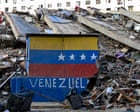
Preliminary analysis of satellite data suggests magnitude of natural disaster could dwarf official estimates
Clavel Rangel in Caracas, Sam Jones and agenciesTue 30 Jun 2026 14.26 EDTFirst published on Tue 30 Jun 2026 14.22 EDTSharePrefer the Guardian on GoogleMore than 58,000 buildings may have been damaged and destroyed by the twin earthquakes that hit Venezuela last week, according to a preliminary analysis of satellite data that suggests the scale of the destruction could dwarf official estimates.
Last Wednesday’s back-to-back quakes – which measured magnitude 7.2 and 7.5 – killed at least 1,943 people, injured more than 10,571, and left tens of thousands missing amid the rubble. The UN migration agency has said that up to 6.8 million people could be affected by the disasters, and would require shelter, water, sanitation, healthcare and essential relief items.
As hopes of finding survivors dwindle, efforts are under way to determine the true extent of the damage. On Monday, Jorge Rodríguez, the president of the National Assembly, said that 855 buildings had been damaged, including 189 “total collapses”.
But initial assessment of satellite data published by US space agency Nasa raises the prospect of far more serious and widespread damage.
After analysing high-resolution radar imagery gathered the day after the quakes by the European Space Agency’s Sentinel-1 satellites, researchers at Oregon State University have concluded that “approximately 58,870 buildings were likely damaged or destroyed across the affected region”.
Magnitude of past earthquakesThey added: “This is a preliminary, rapid assessment. It reflects abrupt surface change consistent with damage.”
Meanwhile, the World Health Organization has sounded the alarm over potential disease outbreaks as Venezuela’s stressed and damaged health facilities struggle to cope with the aftermath of the quakes.
“The health services are under extreme pressure now, with facilities operating beyond the capacity,” spokesperson Christian Lindmeier told a press conference in Geneva.
He added that there was “an increased risk” of outbreaks of measles and diphtheria due to low levels of pre-quake vaccination, as well as of yellow fever, malaria, dengue, chikungunya and Zika.
The WHO said its preliminary findings had found gaps in obstetric care in the hard-hit port city of La Guaira because maternity care workers were still missing after the quakes. It also noted “chaotic service delivery and patient flow, marked by overcrowding [and] growing surgical backlogs”, and said there were problems adequately registering casualties and tracking missing people.
A search and rescue dog hunts for victims amid debris of a demolished building at in La Guaira, Venezuela. Photograph: Edilzon Gamez/Getty ImagesThe government has militarised La Guaira and imposed a permit requirement to enter the disaster zone. The US military has repaired and reopened the city’s port, where at least one a warehouse has been turned into a makeshift morgue for hundreds of unidentified cadavers in body bags.
According to Gianluca Rampolla, the UN coordinator in Venezuela, a total of 27 countries have mobilised nearly 40 search and rescue teams. They include more than 2,000 troops and personnel, along with more than 160 dogs. Rampolla said the UN would provide 10,000 body bags, although it hopes the final toll will be lower.
The wait for news – good or bad – is fuelling growing public anger over the authorities’ failure to prepare for the disaster and to react more quickly once the quakes hit.
Daniela Mangiafico has had no news of her 80-year-old grandmother Josefa Báez Verdejo since the building where they lived in the Tanaguarenas area of La Guaira collapsed last Wednesday. Also missing or trapped are Mangiafico’s three chihuahuas and her five cats.
“My entire life is gone: everything, my grandmother and my pets; all of them are my family,” she said on Sunday. “What happened is that help arrived late. It’s taking too long and, obviously, how can you ask people who are trapped there to wait?”
Two days later, Mangiafico said a voice that could be her grandmother’s had been heard. The family are still hoping that she may have managed to shelter in a space behind her bed.
A man attempts to retrieve casualties from under the rubble of a collapsed building in the Tanaguarena neighbourhood in La Guaira. Photograph: Leonardo Fernández Viloria/Reuters“They have completely forgotten us in Tanaguarenas,” Mangiafico’s sister, Jennifer, said in a video posted on Tuesday morning.
“Rescuers have arrived, but not the kind we need. We need machinery because we can no longer do anything by hand. There’s tonnes and tonnes of rubble that we cannot lift with our hands.”
Nicolás Serrato, a volunteer rescuer from southern Venezuela, said the devastation he had seen in and around La Guaira was staggering.
“Very few buildings are unaffected,” he said. “The vast majority of homes, from small houses to three-storey buildings and huge apartment blocks, are all badly damaged. And those still standing have serious structural problems.”
Serrato said that the estimate of 50,000 damaged buildings tallied pretty well with what he had seen.
“It’s truly brutal,” he said. “All those people who survived are now searching for their families. There is a very deep emergency, and it is extremely important to help now because this is very difficult.”
Agence France-Presse and Reuters contribute to this report
Explore more on these topicsShareReuse this contentMoles of Venezuela: the amateur rescuers digging and delving through the post-quake rubble
4d agoRodríguez defends Venezuela’s earthquake response as death toll passes 3,000
4d ago‘I can only describe it as a war zone’: the rescuers navigating Venezuela’s post-quake hellscape
7d agoVenezuelan man saved from collapsed mall eight days after earthquakes
2 Jul 2026Venezuelan police officers arrested over alleged looting after earthquakes
1 Jul 2026Strong aftershock terrifies Venezuelans days after devastating twin quakes
29 Jun 2026Families of two football players killed and injured in Venezuela earthquakes
29 Jun 2026Mortuary in Caracas ‘overwhelmed’ as Venezuela struggles to respond after earthquakes
28 Jun 2026Survivors tell of ‘brutal and fast’ Venezuela quake as hunt for survivors goes on
26 Jun 2026Venezuela quake death toll reaches 920 as interim president vows to save ‘as many as possible’
26 Jun 2026