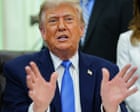
Iranian leadership has not confirmed claim, after the US president announced that planned strikes on Iran had been cancelled
Andrew Roth and Aram Roston in Washington and William Christou in BeirutThu 11 Jun 2026 20.57 EDTFirst published on Thu 11 Jun 2026 10.20 EDTSharePrefer the Guardian on GoogleDonald Trump claimed on Thursday that Washington and Tehran were on the verge of signing a peace agreement, and announced that he was cancelling fresh missile strikes, after two days of escalating attacks on Iran that threatened to collapse the fragile ceasefire.
His comments followed a new bout of public diplomacy by social media, but were dismissed by Iran’s foreign ministry, which said a final decision on an agreement had not been reached.
“Based on the fact that discussions with the Islamic Republic of Iran have been brought to the highest level of Iranian leadership and approved, I have, as President of the United States of America, cancelled the scheduled strikes and bombings against Iran this evening,” Trump wrote on Truth Social, the social network he owns.
While the White House has long sought a peace agreement with Iran – and it would mark a major achievement for this administration – Trump has claimed dozens of times to be close to a deal without any agreement eventuating.
The Iranian foreign ministry spokesperson, Esmail Baghaei, said large parts of the text under negotiation had been finalised but Iran would not compromise on its red lines
“So far, Iran has not reached a final conclusion on the agreement,” Baghaei said.
Tasnim, the semi-official Iranian news agency, wrote that “until a potential understanding is announced by Iran, any news from Trump on this matter should be dismissed”.
A diplomat briefed on the talks said that the deal had largely been agreed to several weeks ago but that there was still a “50% chance” that it will collapse. “There are a lot of potential spoilers,” the diplomat said.
The new agreement would provide for a timeline for demining the strait of Hormuz, during which the US naval blockade would remain in place. It also discusses mechanisms for further nuclear talks and the release of frozen Iranian assets but does not contain concrete agreements about how that will take place.
Trump however, continued to claim that a deal had been reached, telling reporters at the White House that the strait of Hormuz would open “as soon as we sign, which could be soon … maybe over the weekend in Europe.”
Trump claimed the negotiations had been approved by other parties to the conflict, including Israel, which has been publicly skeptical about any deal with Iran. Others included the Gulf states of Qatar, Saudi Arabia and the United Arab Emirates, as well as regional powers Turkey and Pakistan.
Benjamin Netanyahu’s office said in a statement that Israel was not a party to the memorandum of understanding with Iran, but the prime minister “expressed his appreciation” for Trump’s commitment that the final deal would include the removal of enriched material, limits on missile production, and the cessation of support for proxies in the region, measures that have proved to be red lines for Iran in the past.
Just hours earlier, Trump had said the US would take control of Iran’s oil and gas infrastructure and launch further strikes on Iran on Thursday night, after the countries exchanged fire for the second consecutive day despite a nominal ceasefire being in place.
In a post on Truth Social, Trump had said the US would hit Iran “VERY HARD, TONIGHT”, claiming that most of Iran’s offensive capacity had been destroyed. He also said the US would seize Kharg, an island in the Gulf that handles about 90% of Iran’s oil exports and hosts vast storage facilities.
Trump said: “At some point in the not too distant future, we will be taking Kharg Island and other oil infrastructure points, and assume total control of their oil and gas markets, much like we have with Venezuela, which is working out brilliantly for both Venezuela and the United States of America.”
locatorHe later appeared to walk back his threats to seize Kharg, telling Fox News that though his preference had always been to take the island, he did not know if “America has the stomach for it”.
He also said he would rather avoid hitting Iranian bridges and power plants despite having threatened to do so earlier in the week.
The UN secretary-general, António Guterres, on Thursday called on the US and Iran to return to a full implementation of the ceasefire negotiated in April and to avoid further violence that could “trigger a full resumption of the conflict, with unpredictable consequences for the region and the world”.
Analysts have said that taking Kharg Island would require the US to put boots on the ground, exposing US soldiers to Iranian attacks. Ruben Gallego, a Democratic senator and former US marine, said of Trump’s threats to take Kharg Island: “I think he’s putting our men and women in very harsh danger … Kharg Island is a very small, dense place, it’s not that hard to target [our] military formations.”
Responding to Trump’s threats, the head of the Iranian parliament’s national security commission, Ebrahim Azizi, said the US president would receive a stronger and more painful response if he made any “uncalculated” moves.
Iran and the US have traded strikes for two consecutive days, triggered by the downing of a US helicopter above the strait of Hormuz.
The ceasefire, established in early April, has been undermined by sporadic retaliatory strikes, with both sides accusing the other of violating the temporary truce.
Trump said Thursday’s assault was prompted by Iran stalling in negotiations aimed at turning the temporary ceasefire into a permanent peace.
The most intense strikes yet took place on Thursday morning, with the US launching a wide-ranging salvo against what it described as “military surveillance capabilities, communication systems and air-defence sites across Iran”.
The US military said it also struck an oil tanker near the strait of Hormuz that it claimed was attempting to breach a blockade of Iranian ports, firing Hellfire missiles at the vessel.
US forces strike an oil tanker in the Gulf on Wednesday. Photograph: CentCom Photograph: CentComAn Indian official said a US strike had killed three Indian crew members on a ship, though it was unclear whether it was the same one referenced by the US military.
Iran launched missiles and drones at Kuwait, Bahrain and Jordan on Thursday, as it had the previous morning. Bahrain’s interior ministry said an 11-year-old girl had been injured, while homes and vehicles had been damaged by falling debris from interceptions.
Despite the strikes, Iranian officials told Reuters that talks on a preliminary deal had intensified. They said the US and Iran were exchanging messages on a memorandum of understanding, although significant obstacles remained, including how to unfreeze billions of dollars in Iranian assets.
A vessel in the strait of Hormuz near Bandar Abbas beach, Iran, on Thursday. Photograph: Amirhosein Khorgooi/ISNA/Reuters“This war, from a military standpoint, is a dead end,” one Iranian source told Reuters. “The Americans could not achieve their goals by attacking Iran. There has been progress in negotiations.”
The mechanism for releasing frozen Iranian funds remains a significant sticking point. Iran wants the money to be released all at once directly to Tehran, while the US favours a phased approach focused on funding humanitarian goods.
Unfreezing the funds and creating broader economic relief was the priority, according to the Iranian source, rather than an all-encompassing settlement.
Other unresolved issues include the conflict in Lebanon, which Iran insists must be included in any ceasefire framework. Israeli strikes there have reportedly killed more than 3,600 people, while Hezbollah attacks have killed at least 30 Israeli soldiers in Lebanon and Israeli civilians.
Ghada Hussein mourns at the grave of her son Mohammed Tufayli, a Hezbollah fighter who was killed during the war, at a makeshift cemetery in Sidon, Lebanon. Photograph: Anwar Amro/AFP/Getty ImagesTrump wants Iran to end its restrictions on shipping through the strait of Hormuz and guarantee that it will not develop a nuclear weapon – something Tehran has long denied pursuing.
Iran tightened its control over the strait of Hormuz after Wednesday’s attacks, warning that ships transiting the waterway must be patient. The strait is a chokepoint for about 20% of the world’s oil supply and its closure has sent prices of energy and inflation soaring.
The US military denied that the strait had been closed or that its ships had been attacked, despite Iranian claims to the contrary, insisting that vessels were continuing to move through the strait.
Trump is seeking a deal with Iran at a time when the conflict is becoming increasingly unpopular in the US. The president faces midterm elections, rising inflation and plummeting approval ratings.
Gallego said: “It’s never that easy and we certainly shouldn’t be telegraphing our moves or intentions. I think [Trump] is being just way too cavalier about how he’s talking about this.”
Explore more on these topics- Iran
- US-Israel war on Iran
- Strait of Hormuz
- Middle East and north Africa
- US foreign policy
- Energy industry
- US military
- news
US-Iran talks abruptly called off after Israel and Hezbollah trade deadly attacks
2d agoBP board suffers triple climate rebellion from shareholders
23 Apr 2026Iran announces plans to bring in maritime fees for strait of Hormuz
2d agoIran peace deal makes clear how far US has been forced to retreat since 2025
3d agoBP shareholders advised to vote against chair over climate resolution exclusion
7 Apr 2026Green energy boss backs more North Sea oil and gas production from existing sites
24 Mar 2026Trump’s Iran deal is result of unrealistic ambitions for an untenable war
3d ago‘Everyone is angry for different reasons’: scepticism in Iran as peace deal nears
5d agoUK oil firm fined £13m for repeatedly publishing inaccurate financial results
4 Mar 2026Oil prices hit three-month low and markets reach record high amid Iran deal breakthrough
5d ago