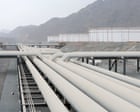
State oil company fast-tracks previously undisclosed project, which is expected to double export capacity
Jillian Ambrose Energy correspondentFri 15 May 2026 07.28 EDTLast modified on Fri 15 May 2026 07.45 EDTSharePrefer the Guardian on GoogleThe United Arab Emirates has announced it will complete a new oil pipeline bypassing the strait of Hormuz by next year to secure its future crude exports against the threat of disruption.
The current blockade of the vital waterway, through which 20% of oil and seaborne gas flowed before the Iran war, is approaching the 11-week mark, sending energy prices soaring around the world and throttling Gulf economies.
Ban private jets and cut speed limits to avert UK fuel crisis, say campaignersRead moreSheikh Khaled bin Mohamed bin Zayed Al Nahyan, Abu Dhabi’s crown prince, has directed the UAE state oil company to fast-track the previously undisclosed project so that the pipeline can begin carrying oil from the emirates to the port of Fujairah by 2027.
The new pipeline is expected to double the UAE’s export capacity via the existing Habshan-Fujairah pipeline which can carry up to 1.8m barrels a day to the port on the Gulf of Oman.
This pipeline has proved crucial to the UAE in continuing oil exports since Iran blocked tankers passing through the strait of Hormuz shortly after the US and Israel launched attacks on 28 February.
The UAE and Saudi Arabia are the only Gulf producers with pipelines that export crude outside the narrow waterway running between Iranian and Omani territory.
The decision to fast-track a second pipeline comes just weeks after the UAE quit Opec after 60 years of membership in a clear sign of a schism with Saudi Arabia, the group’s de facto leader.
mapLeaving the oil cartel was expected to allow the UAE, the group’s third-largest oil producer, to pump more oil than the group’s future production quotas may allow once the conflict ends and normal trade through the strait of Hormuz resumes.
But a new pipeline means the UAE could pursue its plan to ramp up oil exports even if the conflict continues for longer than expected, or an eventual peace plan stops short of allowing a free flow of tankers through the waterway to return to pre-crisis levels.
The UAE’s departure has laid bare the long-running tensions between Abu Dhabi and Riyadh, with the Saudis normally favouring strict production quotas to keep oil prices high enough to support their economic agenda.
The exact capacity of the new pipeline has not been disclosed but doubling its existing capacity to 3.6m barrels a day would bring the UAE’s pipeline exports closer to that of Saudi Arabia, which can transport roughly 7m barrels a day from its eastern oilfields to the Red Sea port of Yanbu, of which 5m barrels are exported.
Explore more on these topics- Oil
- US-Israel war on Iran
- United Arab Emirates
- Strait of Hormuz
- Commodities
- Middle East and north Africa
- news
Oil prices fall as Trump says strait of Hormuz ‘open to all’ if Iran accepts deal
6 May 2026Oil price tops $126 a barrel after Trump warns Iran blockade could last ‘months’
30 Apr 2026UAE quits Opec in win for Trump as oil cartel weakened
28 Apr 2026‘The damage is done’: global oil crisis has changed fossil fuel industry for ever, IEA chief says
24 Apr 2026Oil prices rise and markets fall after US seizure of ship hits Iran peace deal hopes
20 Apr 2026Oil price drops below $90 a barrel after Iran says strait of Hormuz is open
17 Apr 2026Oil price dips below $100 a barrel after Trump claims Iran wants deal
13 Apr 2026$30m an hour: big oil reaping huge war windfall from consumers, analysis finds
15 Apr 2026