Bond yields creep higher on concerns about potential for political instability and rising inflation
Tom KnowlesMon 11 May 2026 10.35 EDTFirst published on Mon 11 May 2026 10.25 EDTSharePrefer the Guardian on GoogleThe cost of government borrowing has crept higher as Keir Starmer’s crucial speech failed to dispel investor “jitters” in the bond markets over political instability combined with fears of rising inflation.
The yield, effectively the interest rate, on the benchmark 10-year UK government bonds (known as gilts) rose eight basis points (or 0.08 of a percentage point) to 5% on Monday.
The yield on 30-year gilts rose 9.3 basis points to 5.67%, edging closer to the 28-year high of 5.78% last week when uncertainty about Starmer’s future as prime minister was intensifying.
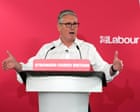
‘There is a good deal of fear’: what would a Labour leadership challenge mean for bond markets?Read moreIn his speech, Starmer said he would fight any leadership challenge and would not walk away from his responsibilities after Labour’s drubbing in local elections in England and parliamentary contests in Scotland and Wales last week.
Borrowing costs fell on Friday as the results of the elections emerged with signs that Labour had not suffered as badly as first feared. Those falls, however, were more than erased by Monday’s rises.
Susannah Streeter, the chief investment strategist at Wealth Club, a non-advisory investment service, said the speech had not “done the trick of calming bond markets”.
“There is still a sense of jitters playing out as concerns about political instability collide with inflationary fears prompted by the ongoing conflict in the Middle East,” she said.
Bond yields move in the opposite direction to bond prices because investors want to pay less and get a bigger reward for the risk of holding them. Higher yields increase the cost of borrowing for the government and eat away at the headroom that the chancellor, Rachel Reeves, has built up against her fiscal rules.
The chief UK economist at Deutsche Bank, Sanjay Raja, estimated last week that more than half of the £24bn margin for error Reeves created by raising taxes in last autumn’s budget may already have been wiped out by higher gilt yields and the prospect of weaker economic growth.
Reeves has sought to win back bond market investors’ confidence since Labour came to power after Liz Truss’s short-lived government alarmed markets in 2022 with huge unfunded tax cuts. Reeves has repeatedly pointed out that £1 in every £10 the public sector spends goes on debt interest and said she is intent on bringing that down.
Investors, however, are becoming increasingly worried that the risk of rising inflation as a result of soaring energy prices linked to the Iran war, alongside in-fighting among Labour MPs over Starmer’s future, will lead to a downgrade in the UK’s creditworthiness.
Part of the worry is that if Starmer is forced out of Downing Street, his possible replacements may seek to increase public spending and loosen the government’s fiscal rules. Two potential frontrunners to succeed him, Angela Rayner and Andy Burnham, have hinted that they would like to see higher public spending.
The deputy chief UK economist at Capital Economics, Ruth Gregory, said: “The UK’s already fragile fiscal position means that investors will be on edge for any signs of fiscal loosening.”
Alongside political uncertainty, the gilt market is also being affected by international developments in the Iran war. Investors believe the UK is more exposed than many other developed countries to the threat of rising inflation from higher energy prices and this is being priced into the yield.
Oil prices rose on Monday after Donald Trump condemned Iran’s response to US proposals to end the war as “totally unacceptable”.
Gregory said: “Most of the recent rise in gilt yields is due to the jump in energy prices, rather than a potential change in prime minister.
“For the gilt market, the war in Iran matters more. If there’s a resolution, market interest rate expectations and gilt yields would probably fall regardless of domestic political developments.”
Explore more on these topicsShareReuse this contentUK borrowing costs fall and pound rises after Starmer says he will stay as PM
3d agoNew threat to Labour spending plans as UK long-term borrowing costs hit highest level since 1998
6d ago‘There is a good deal of fear’: what would a Labour leadership challenge mean for bond markets?
6d agoReeves rightly fears the bond market, but she can afford to ditch one unhelpful rule
18 Apr 2026UK borrowing costs hit highest since 2008 as markets expect up to three interest rate rises
20 Mar 2026UK borrowing costs jump again on fears Iran conflict will curb growth
3 Mar 2026The bond market is wrong. Reeves should not cut welfare to placate the City
9 Nov 2025…… commentsUK government borrowing costs fall to lowest level since July
17 Oct 2025