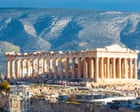
A mathematician has uncovered what may be one of the longest-running myths in history after studying optical illusions and the Parthenon, the famed Greek temple that overlooks Athens.
Scholars have marvelled at the building on the Acropolis hill for more than 2,000 years and heaped praise on its architects for their clever use of geometry. Its subtle curves are said to correct optical illusions that would have otherwise ruined the Parthenon’s clean lines.
But after a detailed investigation, and a flurry of mathematical modelling, Prof Alain Goriely at the University of Oxford has reached an awkward conclusion. The optical illusions the curves are meant to fix are either nonsense or practically imperceptible. In short, the illusions are themselves an illusion.
In his study, Goriely traces the myth back to the 1st-century Roman architect and engineer Vitruvius who wrote about the Parthenon 400 years after its construction. His account found its way into architectural books and became established fact. Today’s AI chatbots still churn out the tale. “I do think it might be the oldest myth that we have,” Goriely said, “apart from religion.”
A common claim that the mathematician challenges concerns the Parthenon’s base or stylobate. Measurements show the sides of the base are not horizontal but form a gentle arc that rises 6cm in the centre. According to Vitruvius, this corrects an illusion that would make the base appear to sag in the middle.
The sagging effect has been attributed to two proposed tricks of the light. The first states that long horizontal lines simply seem to slump in the middle, but Goriely found no evidence for this.
The second suggests that the Parthenon’s marble columns create the illusion. This is based on the Hering illusion where parallel lines on a 2D sheet can look bowed when other lines intersect them. But the Hering illusion is strongest when the intersecting lines are at acute angles. The columns at the Parthenon are too vertical to produce the illusion, and there is no proof it even works in 3D, Goriely said.
Another claim is that the bulges in the Parthenon’s columns – a curvature called entasis – corrects an optical illusion that would make them look too narrow in the middle. Again, Goriely found no evidence for the illusion. Moreover, the columns at the Parthenon bulge by a mere 18mm, which is barely perceptible at typical viewing distances.
Goriely, who assesses and dismisses other supposed “optical corrections” in his paper concedes he “fell into a bit of a rabbit hole” pulling all the evidence together. He suspects the Parthenon’s architects had other reasons for the architectural features.
The curve of the base may have prevented rain puddles forming and curved columns might simply have felt more organic and visually pleasing to the ancient Greeks, he writes in Royal Society Open Science.
It is unclear why the myth has endured for so long, but Goriely suspects that the perception of ancient Greece as a supremely knowledgeable and ingenious civilisation is partly to blame.
Unusually for an academic study, Goriely ends his paper by inviting readers to put it down and take a walk in a city. “Trust your own eyes, question what you see and decide for yourself whether the theory of optical corrections holds up,” he writes.
Frank Salmon, professor of the history of classical architecture at the University of Cambridge, said: “Some experts have long been cautious of Vitruvius’s explanations, recognising the risks inherent in using his text as a sort of bible to explain architectural practices in Greece centuries before his time, but also the loss of the many Greek texts about their temple architecture he claimed to have read when preparing his own.”