If you get Global News from Instagram or Facebook - that will be changing. Find out how you can still connect with us.
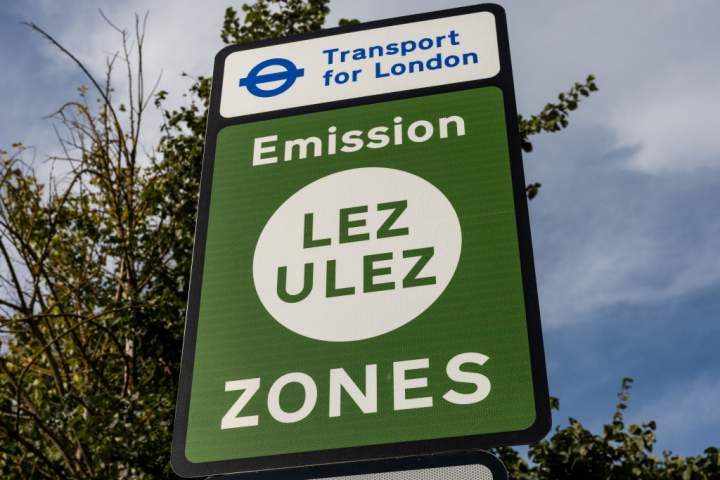
View image in full screen A Transport for London LEZ (Low Emission Zone) and ULEZ (Ultra Low Emission Zone) sign is pictured in Harefield on 26th September 2023 in London, United Kingdom. Mark Kerrison/In Pictures via Getty ImagesChildren’s lung capacity improved significantly after vehicles that cause the most pollution were prohibited from driving in certain parts of London, U.K., designated as low and ultra low emissions zones, a new study found.
Researchers at Queen Mary University of London and Oxford University examined over 3,000 school children aged six to nine in central London and Luton before and after the introduction of the ultra low low emissions zones (ulez) and found that the London children’s’ lung capacity was restored to healthy levels after it was initially stunted by exposure to pollution.
4:17 SFU study finds chemical pollutants in Fraser River Chinook salmon- SFU study finds chemical pollutants in Fraser River Chinook salmon
- Caught-on-camera creek pollution under investigation
- Global negotiations to limit plastic pollution fall apart at UN
- Impact of air pollution on people prone to seizures
Luton, the study’s comparator site, is a town outside of London and does not have any designated clean air zones.
Get weekly health news
Receive the latest medical news and health information delivered to you every Sunday. By providing your email address, you have read and agree to Global News' Terms and Conditions and Privacy Policy.“This evidence supports wider implementation of clean air zones as a public health intervention,” the study says, arguing that it marks an evidentiary breakthrough for an initiative which in the past had been criticized for burdening drivers.
Mayor of London Sadiq Khan introduced the plan more than seven years ago, and wrote in an essay for The Guardian this week that when it was first suggested he faced backlash from his detractors, who he said accused him of declaring “war on drivers in blind pursuit of a policy that may not even work.”
New findings showed it to be effective.
Over four years the study found that the percentage of children with impaired lung function decreased in both London and Luton, from 14 per cent to nine per cent in London and from nine per cent to seven per cent in Luton.
“To our knowledge, we provide the first evidence that air quality improvements following introduction of a clean air zone are associated with improved lung growth trajectories in children,” the study’s authors wrote.
- Australian police find meth hidden inside McMuffin breakfast sandwich
- Ottawa sends officials to Nepal as search for missing Canadians continues
- Sydney shark attack survivor recalls punching animal in the face
- 19-year-old taekwondo champion dead after suffering cardiac arrest in sleep
According to their findings, exposure to traffic related air-pollution is strongly linked to impaired lung development in children and adolescents and failure to reach maximal lung growth poses an increased risk for asthma, chronic obstructive pulmonary disease, cardiometabolic disease, and earlier mortality.
It also showed that children’s lung growth accelerated in ultra low emissions zones and that it was correlated with an improvement in air quality. The depletion of their lung capacity was linked specifically to the presence of nitrogen dioxide.
Based on the evidence researchers concluded that low emissions zones should be implemented more broadly, and on an international scale.
“Children continue to be exposed to poor air quality in cities globally,'” they wrote, “decision makers globally should consider accelerating the introduction of clean air zones to improve children’s lung health.”
There are no similar initiatives currently operational in Canada.
The federal government does set out vehicle emission standards, which require car makers to meet increasingly stringent low emissions requirements.
Toronto has considered implementing congestion charges and low emissions zones to reduce traffic along major travel routes. These policies typically require drivers to pay to use a polluting vehicle within certain areas.
Add Global News as a Preferred Source on Google to see more of our stories in your search results.
Journalistic standards Report an error © 2026 Global News, a division of Corus Entertainment Inc.