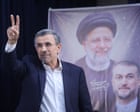
Airstrike at the start of the war was aimed at freeing populist ex-president from house arrest, US newspaper claims
Patrick Wintour Diplomatic editorWed 20 May 2026 10.40 EDTLast modified on Wed 20 May 2026 10.58 EDTSharePrefer the Guardian on GoogleFresh questions have been raised over the US and Israeli effort to depose the Iranian regime after it was claimed that Israel wanted to put the populist Mahmoud Ahmadinejad in power.
Ahmadinejad’s turbulent presidency, from 2005 to 2013, was marked by incendiary attacks on Israel but he recast himself as a critic of the regime and champion of the poor after falling out with the supreme leader Ali Khamenei.
It is claimed that Israel bombed a security building close to his Tehran home to help him escape house arrest but he became uneasy about the operation.
The plans, reported by the New York Times, were widely seen as implausible or as disinformation put out by Ahmadinejad’s supporters or the Israeli intelligence services.
However, the episode shows that the US and Israel overestimated opposition to the regime and their own ability to bring it down it with airstrikes.
Mahmoud Ahmadinejad in Isfahan in 2009, midway through his eight years as Iran’s president. Photograph: Ebrahim Noroozi/APDonald Trump, faced with domestic anger over rising gas prices, has been seeking to extricate himself from the conflict but is considering more airstrikes to force Tehran to meet his terms.
The US president said on Monday that he had delayed a fresh attack after an intervention by Gulf leaders. But on Tuesday he held a lengthy phone call with Israel’s prime minister, Benjamin Netanyahu, which covered the potential resumption of hostilities.
Asked if Israel could be stopped from attacking Iran, Trump told reporters on Wednesday: “Netanyahu will do whatever I want him to do. He’s a great guy, To me he is a great guy.”
Trump said he wanted to see the strait of Hormuz opened but denied he was under pressure, adding: “I am in no hurry. Everyone says ‘oh the midterms’, I am in no hurry. Ideally I would like to see a few people killed as opposed to a lot. We can do it either way.”
Tehran, which believes its stranglehold on western economies is tightening, refuses to agree to Washington’s demands on domestic uranium enrichment. It wants to delay negotiations on the future of its nuclear programme and instead focus on lifting sanctions in return for the end of its blockade of the strait of Hormuz.
The US has mounted a counter-blockade of Iran’s ports in an attempt to stop its oil shipments, which principally go to China as its single biggest source of export revenue. The Islamic Revolutionary Guard Corps warn they will widen the war beyond the region if Trump resumes his assaults.
Iranian media treated the New York Times report with scepticism, and said the former president had not been under house arrest.
At the time of the initial Israeli attacks on Tehran, on 28 February, there were reports in the Iranian media that Ahmadinejad had been killed in a strike on his home.
It later emerged that a security outpost outside his home in Narmak, north-east Tehran, had been hit – an attack confirmed by satellite images. It was speculated that Ahmadinejad would use the mayhem to make a bid for power.
In the days after the airstrikes, official news agencies reported that he suffered minor injuries but his bodyguards were killed.
Ahmadinejad would be an unlikely ally for Netanyahu because of his Holocaust denial and virulently anti-Israeli policies.
Trump had made it clear at the outset of the attacks on Iran that he wanted to follow the model of Venezuela where US troops captured the country’s leader, Nicolás Maduro, but left the regime in Caracas intact. Maduro’s deputy, Delcy Rodriguez, is largely cooperating with Washington but Ahmadinejad’s fraught relationship with the regime in Tehran makes a similar arrangement in Iran less likely.
Ahmadinejad’s authority declined markedly when he fell out with Khamenei in 2011 and – a year later – his rival, Ali Larijani, was elected parliament’s speaker. Their disputes centred on ministerial appointments and economic policy as well as Ahmadinejad’s nationalism, which included the glorification of ancient Iran.
He was arrested in 2018 after criticising the government led by his successor, Hassan Rouhani. He was reported as saying: “Some of the current leaders live detached from the problems and concerns of the people, and do not know anything about the reality of society.”
Ahmadinejad has been repeatedly blocked from standing again for the presidency, including in 2024. After that, he fell largely silent and issued only the most mild criticism of the Israeli strikes on Iran in 2025.
In a sign of how far his views have changed, he was reported to have visited pro-Israel Hungary to give a talk last June. It was one of the few foreign trips he has made since ending his presidency and the visit would have been sanctioned by the government.
Explore more on these topics- Iran
- US-Israel war on Iran
- Mahmoud Ahmadinejad
- Middle East and north Africa
- US foreign policy
- Benjamin Netanyahu
- Strait of Hormuz
- news
Trump threatens ‘a big hit’ if Tehran does not make deal soon
21h agoJD Vance says US remains ‘locked and loaded’ to restart military campaign as Iran warns of ‘new fronts’ – as it happened
20h agoStrike near UAE reactor revives concerns over nuclear plant safety in wartime
1d agoTrump claims planned attack on Iran postponed after Tehran makes new proposal to end war
2d agoHow realistic is threat of Iran charging to use internet cables under strait of Hormuz?
2d agoUAE blames Iran or proxies for strike near nuclear plant, as Trump tells Tehran ‘clock is ticking’
2d agoOman caught between US and Iran after Tehran’s claims of joint strait of Hormuz plan
5d agoBenjamin Netanyahu says he made secret trip to UAE at height of Iran war
6d agoUAE’s secret attack on Iran risks drawing Gulf states into the war
12 May 2026