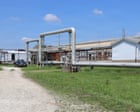
Plans by the US army to detonate about 5 tons of bomb-making chemicals that have become unusable and might explode if moved have residents in south-east Iowa worried that a cloud of lead dust could cause environmental contamination and health problems.
The detonation at the Iowa army ammunition plant is scheduled for Friday, and officials recommend that some residents in nearby Middletown begin vacating the area that morning. If they cannot leave their homes, they should stay inside and keep windows and doors closed.
“The detonation will result in an air plume with some lead-containing particles which will disperse in the air and deposit on the ground,” an advisory states. “Lead is toxic to humans and animals. The goal of this advisory is to provide the public with actionable information out of an abundance of caution to minimize lead exposure.”
Babies more likely to have heart defects from Louisiana’s areas with industrial pollution, study findsRead moreOfficials have released maps showing the potential for lead dust to drift north. Updated maps showed the plume’s shift, and the army will continue to update the map based on weather. Some schools in the path of the plume have already canceled classes.
Nearly 400 people live in Middletown, but there are thousands more in the path of the plume.
The vibrations from the two blasts would not last long but could break old windows in town, and the resulting dust was expected to linger for no more than one hour, depending on wind speed, officials said.
While the army recommends cleaning cars, windowsills and outdoor surfaces after the detonation, residents have taken to social media to voice concern and question whether that will be enough.
Surrounding communities get late notice
Middletown residents learned in March that the army needed to dispose of several dozen barrels containing lead azide, after the ammunition plant paused operations as part of a review and the degraded material was discovered.
“The safety of our people and our neighbors is non‑negotiable,” Lt Col Daniel Nosse, the commander of the plant, said at the time, acknowledging the volatility of the chemical compound used in munitions production.
The army shared more details during a public meeting in Middletown in October, advising that a detonation was planned for an unspecified date in November. The Environmental Protection Agency (EPA) on 13 November approved an emergency permit, paving the way for Friday’s detonation.
That permit required the army to track specific rates of potential air and dust dispersion and notify the public five days in advance, prompting Sunday’s advisory to communities as far as 100 miles (160km) away.
Just a few miles north-west, the Danville community school district will close on Friday, the superintendent said in an announcement on Tuesday. Pat Wallace said his initial intention was to keep schools open, but there were enough uncertainties that made canceling “the most responsible decision”.
“I am not suggesting that the detonation will result in unsafe conditions,” he wrote. “The reality is that we simply do not know exactly what conditions will look like Friday afternoon.”
In Mediapolis, less than 20 miles (32km) north-east of the ammunition plant, city officials were approached about allowing soil, water and air testing late last month. But they only learned of their potential exposure on Sunday, when the initial map put them dead-center in the dust exposure area. Schools and the public library will close on Friday and the local fire department planned to hose down playgrounds that could be covered in lead particles.
The city of nearly 2,000 residents was no longer in the plume in an updated map.
“This is probably a first for me. I believe it’s a first for a lot of our citizens,” the deputy city clerk, Amy Stucker, said on Wednesday. “The biggest issue we’re having is the lack of information.”
The office of the Iowa governor, Kim Reynolds, was first briefed on Monday about the public advisory, her office said.
News of the planned blasts also caught the attention of environmental and public health officials in Illinois. They urged the US military to conduct comprehensive sampling in that state after the detonations.
The barrels of lead azide had been stored at the ammunition plant for more than 20 years in earthen containers, sitting in a bath of ethanol and water to keep the material stable, said Justine Barati, public affairs specialist at the army sustainment command.
During a routine check earlier this year, the army found that some of the water had evaporated, causing the lead azide to crystallize. That makes it more sensitive to friction and shock, thus “creating a highly unstable and dangerous situation”, according to an emergency permit approved last week by the EPA.
Moving or relocating it posed an unacceptable risk of accidental detonation, officials said. Barati said that possibility increases in cold weather.
“We’re really concerned about the weather situation,” Barati said about moving forward with Friday’s detonation. “We’re really concerned that it will detonate on its own.”
The army said it put together a panel of experts in munitions chemistry, engineering and environmental safety to come up with the detonation plan.
The barrels are surrounded above, below and on all sides with concrete, which is buried under soil. Sand barriers are stacked two storeys high around the soil.
During the detonation, the soil will be sprayed with water and the air will be misted to try to keep the majority of lead on army property, Barati said.
Young children are a particular concern for potential exposure
Patrick O’Shaughnessy, a professor at the University of Iowa’s department of occupational and environmental health, said it was encouraging to see that the army and the EPA were doing all they could to minimize the dust, but it was still unknown how much would end up in the atmosphere and on surfaces.
Lead is a neurological toxicant that can decrease brain activity and development, especially in young children, O’Shaughnessy said. He is particularly concerned for toddlers who are at the age of putting everything in their mouth.
According to EPA documents, alternatives such as neutralizing and decomposing the contents of the drums using other chemicals were considered. But officials said any plan that involved handling the drums would increase the probability of accidental, fatal detonation.