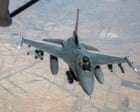
The US military has launched a new wave of attacks against Iran amid the escalating standoff over the strait of Hormuz, with Tehran saying the latest strikes had “rendered futile” all the diplomatic efforts of the past few months.
The US military began launching more strikes against Iran at 9pm GMT on Sunday, US Central Command (Centcom) said on X, “to continue degrading their ability to attack civilian mariners and commercial ships freely transiting the Strait of Hormuz”.
It added that President Donald Trump “has directed the strikes to hold Iranian forces accountable”. Trump, referring to the weekend strikes on Iran, said: “We’re beating them up.”
Iran retaliated by attacking nations in the region hosting US military forces. Jordan’s army said it had shot down four Iranian missiles. Kuwait’s armed forces said they were responding to “hostile aerial targets” on Monday as Iran carried out strikes on US interests in the Gulf.
The strikes were the latest in a cycle of attacks and counterattacks as Iran seeks to assert control over shipping through the vital energy route, but the barrage marked an escalation in pace and range. Centcom said it carried out about 140 strikes on Saturday night.
Trump rejects Iran’s strait of Hormuz closure claim as fight for control goes onRead moreThe renewed violence has cast further doubt on the future of an interim US-Iranian truce agreement signed last month. Centcom said some ships were continuing to cross the waterway.
Iran’s earlier strikes on Sunday extended to Qatar, a mediator in ceasefire talks that had not come under attack since April. The United Arab Emirates, which had not been targeted since early May, said its air defences had engaged missiles and drones from Iran.
Iranian media said on Sunday there had been missile attacks and explosions around the port cities of Sirik and Bandar Abbas, home to military facilities on the Hormuz strait, and nearby Qeshm Island.
Iran condemned the latest wave of US attacks, with the foreign ministry saying they had “rendered futile all efforts of the past few months to reduce tension and establish peace in the West Asian region”.
The ministry also said in the statement: “The US regime has also caused the return of insecurity in the strait of Hormuz and disruption of international commercial shipping by openly interfering in the process of Iran implementing the necessary arrangements in the strait of Hormuz.”
The ministry also said talks between Iran and Oman on Saturday in Muscat – focused on arrangements for managing the strait and transit routes – were unable to reach a result because of “overt and covert” US pressure on Oman.
In the past week Trump has said he considers the ceasefire over, while leaving the door open to more talks. However, Iran’s top negotiator, Mohammad Bagher Ghalibaf, posted on X on Sunday: “The era of one-sided deals is OVER. We told you: keep your word or pay the price. Reality is knocking.”
The flare-up is the latest to undermine the interim agreement between Washington and Tehran that aimed to reopen the Hormuz strait and end the war after a further 60 days of negotiations. The conflict has caused global economic shock waves since it began in late February, driving energy prices higher and fuelling global inflation. Higher prices – especially for petrol – are politically sensitive for Trump ahead of November’s US congressional elections.
Europe considering proposals to allow navigation fees in strait of HormuzRead moreOil prices, which had tumbled since the announcement of the agreement, rose more than 3.5% when futures trading opened on Monday in Tokyo, with the US benchmark WTI jumping above $74 a barrel.
Iran has sought to establish a permanent system for collecting fees in the strait, which carried a fifth of the world’s oil and liquefied natural gas shipments before the war, and has warned vessels not to sail without its authorisation.
Iran’s recently created Persian Gulf Strait Authority said on Sunday that passage through the strait was not currently possible due to what it called recent illegal US military movements in the region. Permits would be issued “as soon as stability and calm are restored”, it said.
The US, which revoked the licence authorising the sale of Iranian crude oil on Tuesday after earlier attacks on shipping, said its forces were positioned to safeguard freedom of navigation despite what it described as “aggression, harassment, threats and arbitrary declarations” from Iran.
The US Navy-led Joint Maritime Information Centre reiterated guidance that, despite a severe security threat, an “expanded” southern route near Oman was available for two-way traffic.
Centcom said on Saturday that US forces had hit more than 300 Iranian military targets over three nights this week, while Iran’s Revolutionary Guards said that in response it struck targets in Jordan, Kuwait, Oman and Qatar – claims that were unable to be independently verified.
With Agence France-Presse, Reuters and AP